


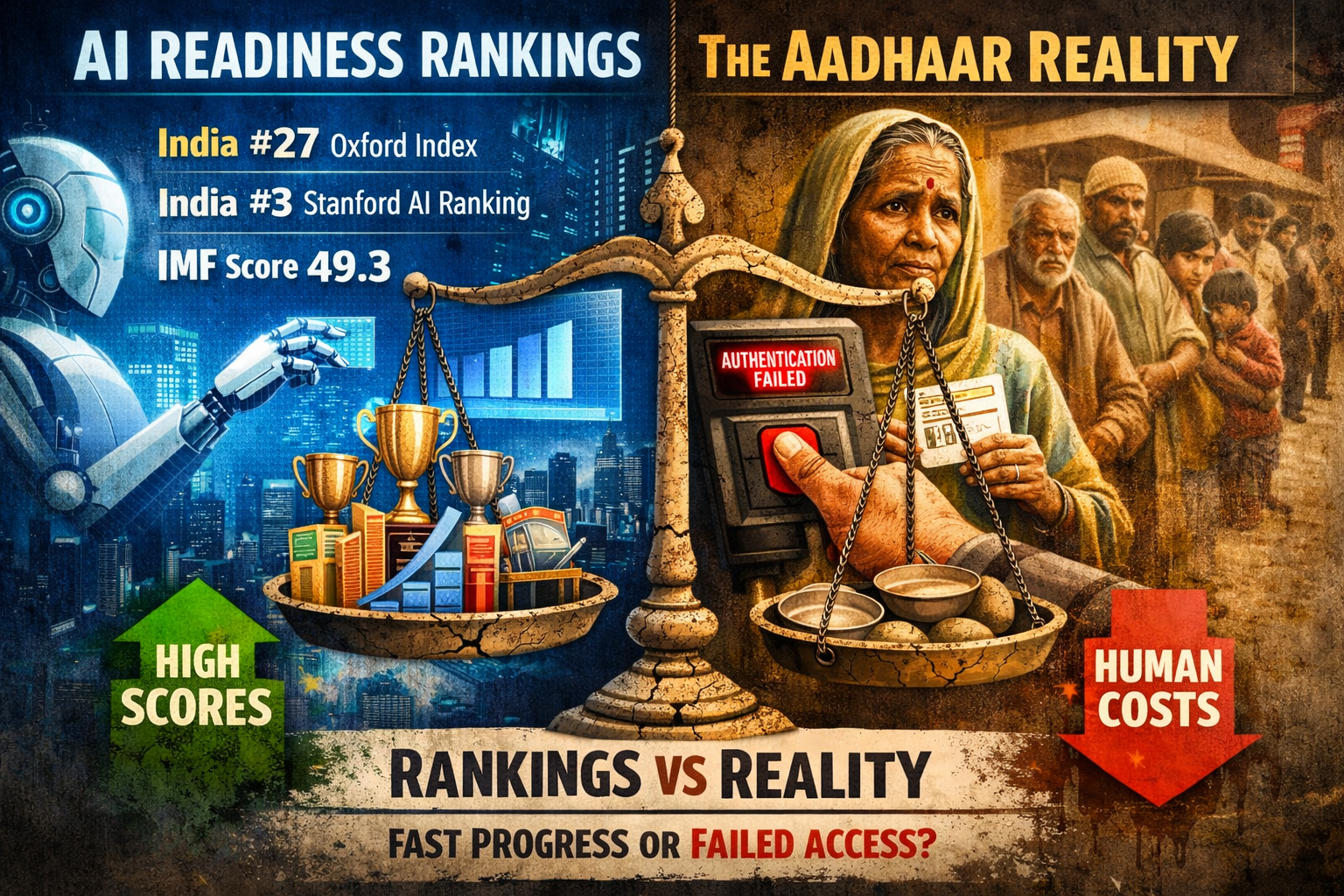
AI readiness rankings are misleading, and India has been basking in limelight over it because these rankings measure how fast the government can deploy automation, not how fast it can fix a problem when automated decisions wrongly lock citizens out of services.
Rankings from global institutions track inputs like research, talent, and infrastructure. However, India’s real bottleneck sits downstream: appeals, overrides, and clear accountability when systems fail at population scale.
For Example, India ranks 27th in Oxford Insights’ Government AI Readiness Index 2025, holds the third position in Stanford’s AI Vibrancy Ranking, and achieved a score of 49.3 on the IMF’s AI Preparedness Index. These figures highlight progress in areas such as AI governance and automated decision-making, thereby augmenting the AI readiness rankings.
However, in July last year, the Indian Public Accounts Committee in Parliament heard alarming testimony about the frequent failures of Aadhaar biometric authentication. These failures are leaving many deserving individuals without access to essential services, like subsidized food rations and rural employment programs. It’s a troubling situation that affects those who rely on these resources the most.
That gap between ranking and reality isn’t a data quirk. It’s a warning that global AI readiness rankings reward exactly the wrong capabilities for a country governing 1.4 billion people, and India is paying the price in excluded citizens, jammed grievance systems, and accountability that dissolves into vendor contracts.
What Rankings See, And What They Miss
Oxford Insights frames its index around a single question, and the question is “To what extent can a government harness AI to benefit the public?” Similarly, the IMF tracks digital infrastructure, human capital, innovation ecosystems, and legal frameworks across 174 economies.
Whereas Stanford measures research output, venture capital, and notable model development. All three places India is in the top tier of emerging economies, and New Delhi eagerly cites these numbers in budget speeches and strategy documents.
Yet none of these frameworks ask the question that matters most at India’s scale. How many automated decisions can the government realistically reverse in a day? When frontline officials override a system to help an excluded citizen, do they face audit penalties months later?
When biometric authentication fails for a manual laborer with worn fingerprints or an elderly woman whose iris patterns have changed, how long does correction take, and does it arrive before the family misses meals?
AI readiness rankings don’t measure that capacity because most countries don’t operate at population scales where one-percent error rates become mass exclusion events. India does. And that difference makes global benchmarks actively misleading for Indian policymakers.
The Aadhaar Reality Check
India’s biometric identification system offers the clearest evidence that deployment speed and reversibility capacity move at different speeds. The Comptroller and Auditor General documented more than 475,000 duplicate Aadhaar enrollments in 2022, cases where identical biometric data linked to different residents, and gaps in how authorities track authentication failures or analyze complaints. Parliamentary committees have flagged these patterns for years, yet automated decisions keep outpacing accountability.
In July 2025, Public Accounts Committee hearings sharpened the picture. Members across party lines warned that faulty fingerprint and iris scans block people from accessing the Public Distribution System and work opportunities through rural employment programs.
Committee Chair KC Venugopal called it “a common man’s issue,” while officials acknowledged that laborers’ worn biometrics and elderly citizens’ changed iris patterns no longer match UIDAI records, resulting in wrongful exclusions.
These aren’t edge cases; they’re structural features of any biometric system operating at scale. Yet AI governance frameworks and AI readiness rankings treat Aadhaar as a digital infrastructure success rather than an accountability warning, and automated decisions continue to drain accountability from systems that the EU AI Act would classify as high-risk.
Scale Breaks Assumptions
Global rankings implicitly assume governments operate at scales where human review remains possible. That assumption fails in India. When authentication systems process hundreds of millions of transactions monthly, even tiny error rates generate grievance volumes that overwhelm correction capacity.
The India AI Mission recently committed over INR 10,000 crore to datasets, compute infrastructure, and AI solutions in healthcare, agriculture, and governance in its second tranche. That investment will accelerate automated decision-making across sectors.
Yet nowhere in the mission’s seven pillars does “reversal capacity” appear as a measurable goal. The government plans to train three million officials in AI and emerging technologies, but training bureaucrats to use systems differs fundamentally from empowering them to override systems when automation harms citizens.
This is where AI readiness rankings actively mislead. They reward compute access, talent pipelines, and deployment announcements, all inputs that accelerate automation. They ignore appeal capacity, override speed, and clear accountability chains, all outputs that determine whether automation serves or harms people at scale.
What India Should Measure Instead
If India wants to lead in AI governance rather than just climb AI readiness rankings, it needs different metrics. Let’s consider some important questions that affect real people’s lives. First, how many Aadhaar authentication failures happened last month? It’s crucial to know how many of these issues were resolved within 24 hours because timely corrections can mean a lot to individuals relying on these services.
Next, think about when a frontline official steps in to override an automated decision. It raises concerns about accountability, what percentage of these officials face disciplinary action later on? Understanding this can shed light on the fairness of the system.
Finally, we need to look at the impact of automated decisions on families. When people are wrongly excluded from welfare programs, how long do they usually wait to get those mistakes fixed? And unfortunately, how many families never see those corrections made? These statistics can really highlight the challenges many face in accessing the support they need.
These questions sound unglamorous compared to Stanford rankings or IMF preparedness scores. They are also the questions that determine whether AI readiness rankings translate into actual governance capacity or just institutional debt that accumulates until systems fail spectacularly.
Consider the EU AI Act, which mandates human oversight for high-risk systems and requires that automated decisions can be explained, audited, and overturned. Europe built these guardrails before deployment, yet critics still warn that slow review cycles and understaffed oversight bodies leave regulators reacting after harm rather than preventing it.
Europe, despite having smaller populations and a well-established administrative framework, finds it challenging to reverse certain decisions and policies. In contrast, India faces an even tougher challenge due to its larger population and unique complexities. The hurdles India confronts are on a much larger scale, making the task of achieving reversibility significantly more daunting.
Measuring What Matters
Until AI readiness rankings measure reversibility, they will keep misleading India by rewarding deployment speed over accountability. Oxford Insights, the IMF, and Stanford track valuable inputs, talent, infrastructure, and innovation, but they ignore the output that matters most: whether automated decisions can be stopped cleanly, reviewed fairly, and corrected quickly when they fail.
India’s Parliament is asking the right questions about Aadhaar authentication failures. Now India needs to answer them with metrics that matter, not rankings that celebrate how fast we automate, but measures that show how fast we can reverse course when automation harms the “common man” that Committee Chair Venugopal rightly placed at the center of this debate.
The next phase of AI governance won’t belong to countries that deploy fastest. It will belong to those who can stop systems without chaos, reverse outcomes without litigation, and govern automation without surrendering authority to it. Until India measures that capacity, global rankings aren’t mapping readiness; they’re mapping exposure.
Stay ahead of the curve and follow IndiaTechDesk on Facebook, Twitter and Linkedin for in-depth news of market trends, funding updates, and regulatory changes affecting startups in India.
Read More:
- India Needs More Neutral Colocation Space for Supporting AI Startups
- Deeptech Startups India, Can Policy and Capital Deliver?
- India’s Climate Unicorns Rise on Renewable Energy and Smart Policy Moves
- India Chooses Scale Over Supremacy in Global AI Race
- Government of India’s Drone PLI Scheme to Buoy the Sector towards Future Growth