


Union Budget 2026-27, presented by Finance Minister Nirmala Sitharaman, marks a strategic pivot for India’s startup ecosystem by moving beyond company creation to scaling deep-tech ventures through targeted allocations such as ISM 2.0, a Deep Tech Fund of Funds, and an expanded AI Mission, while continuing strong infrastructure spending and credit support frameworks.
For the first time, India’s Union Budget for 2026-27 emphasizes fostering a select group of globally competitive firms rather than simply increasing the number of startups. This marks a significant turning point for the Indian startup ecosystem, indicating that it has matured beyond the initial experimental phase.
Policymakers now view deep-tech startups as crucial assets for the country’s growth. To support this shift, they are implementing three key strategies: creating larger funding pools, similar to equity investments; focusing on mission-driven spending for deep-tech initiatives; and improving access to working capital for B2B founders by expanding startup credit guarantee programs. This approach not only highlights the evolving innovation landscape in India but also aims to create a strong foundation for sustainable growth.
Instead of launching flashy new slogans, Union Budget 2026-27 lays capital on existing architectures and tightens the focus on hardware, life sciences, AI and quantum computing, and defense-linked innovation.
“Given that deeptech is being seen as an area for growth at the national level, with a China +1 macro and the creation of the PLI/DLI schemes of the government, this is a great step. The Government has created this FoF for deeptech to enable funds to invest in deeptech and back highly innovative startups that can put India in a competitive global AI race,” said Bhaskar Majumdar, Managing Partner, Unicorn India Ventures.
Who actually receives financial support?
The Union Budget for 2026-27 introduces several changes, particularly aimed at supporting growth-stage entrepreneurs. At its heart is a redesigned financial strategy designed to help bridge the “valley of death” that many startups face. One of the standout initiatives is an INR 10,000 crore SME Growth Fund, which aims to nurture “champion SMEs” that can drive significant economic contributions.
Additionally, there’s an INR 2,000 crore boost to the Self-Reliant India Fund, which focuses on increasing equity capital for businesses caught in the tricky space between early-stage startups and more established, bankable ones.
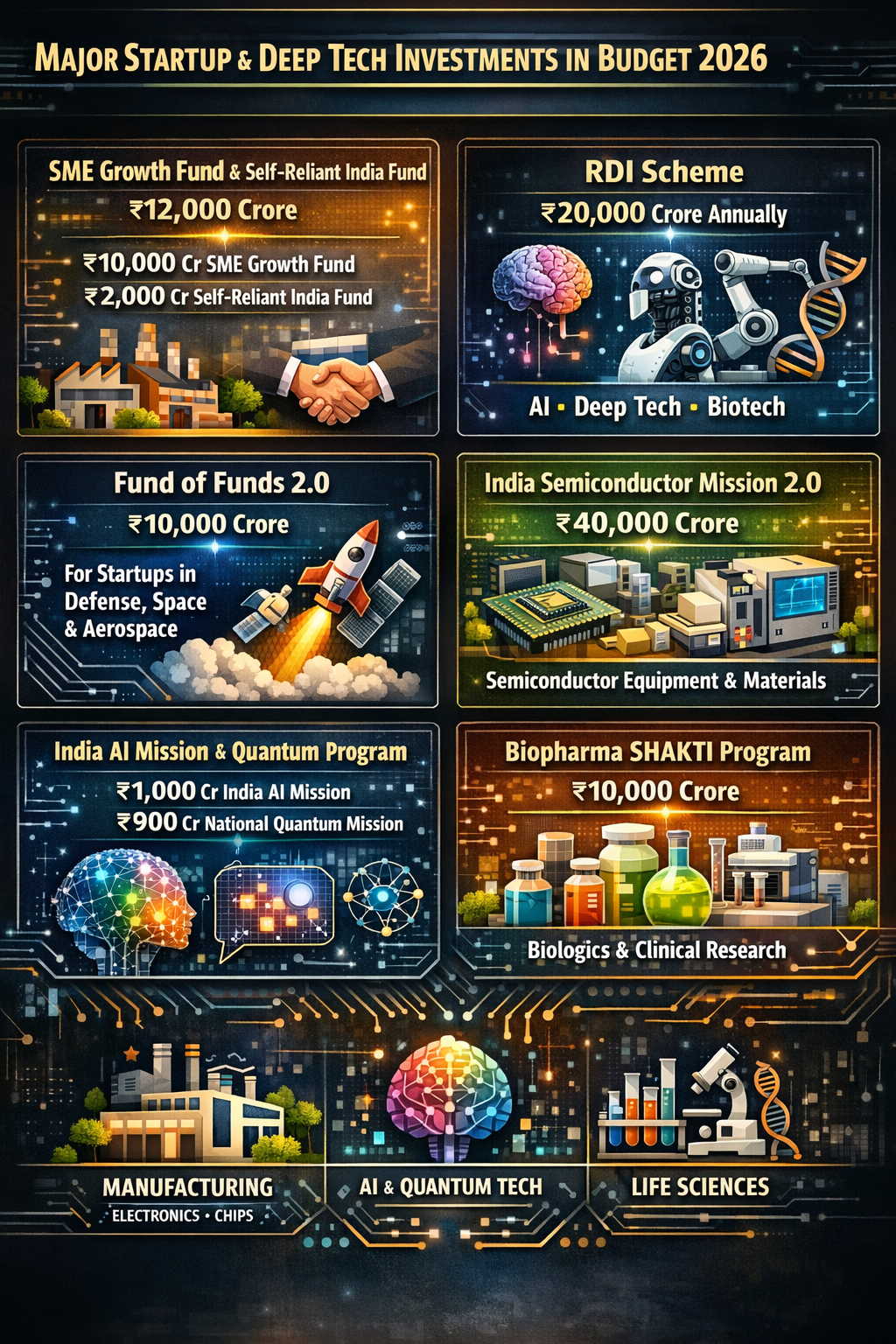
On the deep tech front, the RDI Scheme has a substantial annual budget of INR 20,000 crore. Interestingly, it opts for concessional loans over equity, allowing capital-intensive deep-tech startups to access capital at lower costs without putting too much of their ownership stake on the line too soon.
Finally, there’s an INR 10,000 crore Fund of Funds 2.0, which seeks to improve on the original FFS model by targeting sectors such as defense, aerospace, and space. However, the cautious rollout of FFS 1.0, with only about a third of its funds deployed, serves as a reminder to tread carefully. Overall, these initiatives reflect a commitment to fostering innovation and strengthening India’s entrepreneurial ecosystem.
“The 2025 Budget presents a pragmatic approach to startup growth. The new ₹10,000 crore Fund of Funds, combined with streamlined business registration processes, shows that we’re moving beyond mere funding to creating an enabling environment for innovation,” said Ganesh Raju, Founder & CEO at Turbostart & Kenverse.
Semiconductor mission India moves up the stack
In a clear signal to global supply chains, the Union Budget 2026-27 doubles down on the Semiconductor Mission India by pivoting from fabs to equipment, materials, and design. India Semiconductor Mission 2.0 reserves about INR 40,000 crore to build domestic capability in the very tools and materials that fabs require, betting that deep-tech startups can serve both Indian fabs and international buyers.
This new emphasis sits alongside an expanded electronics components manufacturing scheme, whose outlay jumps from INR 22,000 crore to INR 40,000 crore after the government received almost triple the number of expected applications. For investors, the message is blunt. If you ignore Semiconductor Mission India and related deep-tech startups, you ignore the budget’s core bet.
“The announcement of an INR 20,000 crore investment to drive private sector-led research, development and innovation is a game-changer for India’s DeepTech ecosystem. Given the capital-intensive, long-gestation nature of DeepTech ventures, we hope this enables experienced DeepTech-focused fund managers to deploy capital effectively,” said Anirudh A Damani, Managing Partner, Artha Venture Fund.
AI and Quantum Computing, Small Investments, Big Impact
The Budget for 2026-27 allocates substantial funding for various technological sectors, with semiconductors receiving the largest share. However, there is also a dedicated focus on artificial intelligence (AI) and quantum computing, albeit through smaller, targeted allocations.
The India AI Mission has been allocated approximately INR 1,000 crore to promote practical use cases in healthcare, education, and public services. This funding reflects a trend toward establishing recurring revenue streams for AI and quantum computing startups, which are considered more feasible than purely research-oriented endeavors.
Additionally, the National Quantum Mission‘s budget has increased to around INR 900 crore, up from about INR 600 crore previously. This enhancement underscores the importance of quantum computing in critical sectors such as security, finance, and advanced scientific computations.
A deep-tech investor based in Delhi noted that quantum technology has evolved beyond a mere scientific experiment, as stakeholders in the Indian startup ecosystem now expect viable commercial models, not laboratory prototypes, from deep-tech startups focused on quantum initiatives.
Biopharma and life sciences, from quantity to quality
Beyond chips and code, the Union Budget 2026-27 delivers a significant push to biopharma through the Biopharma SHAKTI program, which earmarks about INR 10,000 crore over five years. Instead of simply pushing more generics approvals, the plan funds clinical trial infrastructure, regulatory capacity, and three new NIPER institutes to deepen the talent pipeline for advanced biotech.
Founders in the biopharma sector often face lengthy timelines and high failure rates, so the introduction of Biopharma SHAKTI is likely seen as a valuable resource that helps reduce risk. It also signals India’s commitment to producing high-quality biologics and biosimilars, which is encouraging for the industry.
For global pharmaceutical investors monitoring India’s startup scene, these developments are as significant as the semiconductor initiatives. They not only enhance the credibility of the growth narrative but also emphasize the importance of maintaining high standards in this rapidly evolving market.
Comparative Analysis
The Indian startup ecosystem has articulated several unmet capital needs. The budget partially addresses these:
| Ecosystem Request | Budget Response | Verdict |
|---|---|---|
| Extended tax holiday (15 years vs. 10) for deep tech | Window extended to 2030 incorporation deadline; no additional years granted | Partial |
| Seed funding increase (₹1 crore target) | SISFS allocation maintained; no increase announced | Unmet |
| GST relief on edtech and digital tools | No GST change announced for education technology | Unmet |
| DPIIT recognition extension post-10 years | No extension for mature but profitable startups | Unmet |
| Fintech compliance and tax rationalization | General digital infrastructure support; no fintech-specific relief | Partial |
| Extended recognition for deep-tech startups | Recognition extended via 2030 incorporation window | Partial |
TReDS, CPSE mandates, and credit guarantees
The capital allocations outlined in India’s Union Budget for 2026-27 do not operate in isolation; they depend on improved financial infrastructure to effectively reach founders. A significant change requires all Central Public Sector Enterprises (CPSEs) to process Micro, Small and Medium Enterprises (MSMEs) procurement invoices through the RBI-regulated Trade Receivables Discounting System (TReDS) platform. This shift could accelerate the discounting of tens of billions of dollars in annual invoices to 24–48 hours, reducing the typical 60–90-day wait time.
Additionally, the government is building on the revised startup credit guarantee framework, which has doubled the maximum per-borrower guarantee from INR 10 crore to INR 20 crore. It has also increased guarantee coverage to 85 percent for smaller loans while reducing annual fees to 1 percent across 27 champion sectors.
This expansion means that bank risk models are now likely to consider many deep-tech startups and Software-as-a-Service (SaaS) companies creditworthy in ways that were previously not feasible under the prior startup credit guarantee framework.
Execution, the billion-dollar question
Even so, numbers on paper mean little without execution, and historical data casts a shadow over the Indian Union Budget 2026-27. In 2025-26, several flagship schemes, including the Jal Jeevan Mission and the RDI Scheme, spent only a fraction of their allocations, with execution in some cases dropping to 15–25 percent.
If current trends continue Indian startups might end up providing closer to INR 70,000 crore in actual funds. This comes alongside a forecast that total government spending for 2026-27 will reach around INR 53.47 lakh crore, with capital investment estimated at INR 12.21 lakh crore.
A fund manager from Mumbai highlighted an important point for founders: they need to monitor how funds are actually being used, rather than focusing solely on announcements. For deep-tech startups in particular, it’s crucial to closely monitor factors such as tender timelines, scheme guidelines, and data on CPSE TReDS adoption, just as they monitor their valuation metrics.
Seven Budgets, Seven Philosophies Post-Covid
Comparing consecutive budgets reveals a fundamental transformation in government thinking. Budget 2020 allocated no dedicated startup capital, instead offering regulatory relief by raising the turnover threshold from INR 25 crore to INR 100 crore. The government assumed private venture capital would flow if compliance barriers fell.
COVID-19 shattered that assumption. Budget 2021 introduced the INR 945 crore Startup India Seed Fund Scheme and INR 3 lakh crore Emergency Credit Line Guarantee Scheme, acknowledging that startups needed government-backed liquidity to survive.
The 2024 budget delivered a watershed moment: the complete abolition of the angel tax. The tax, which had created an INR 30,000+ crore friction in early-stage funding since 2012, disappeared entirely for all investor classes.
IAN Group co-founder Dr. Saurabh Srivastava called it “the single biggest gift the Finance Minister could have given to Indian startups.”
Budget 2026 synthesizes these approaches, combining capital structures (INR 40,000 crore across equity and debt instruments), manufacturing infrastructure (INR 80,000 crore for semiconductors and electronics), and operational enablers such as the mandatory adoption of the Trade Receivables Electronic Discounting System for government enterprises.
How founders and investors respond
For founders, the India Union Budget 2026-27 creates a clear playbook: align with the semiconductor mission, India, AI and quantum computing, or biopharma; secure DPIIT recognition where possible; and design capital stacks that blend equity, concessional loans, startup credit guarantee-backed debt, and invoice discounting.
Growth-stage teams with INR 10–100 crore in revenue stand to gain the most by aligning their business models with the government’s deep-tech startup priorities and navigating the Indian startup ecosystem’s complex compliance landscape.
For global investors, the budget signals that India wants to become a serious hardware and biotech power, not just a software-export factory. Yet the ultimate verdict on Union Budget 2026-27 will not hinge on line items alone. It will depend on whether execution speed, state capacity, and private capital converge quickly enough to turn today’s allocations into tomorrow’s scaled winners in the semiconductor mission, AI and quantum computing, and beyond.
“The government’s renewed commitment to fostering innovation through the additional INR 10,000 crore Fund of Funds for Startups is a significant boost for the entrepreneurial ecosystem. Such measures not only ease capital constraints but also foster an ecosystem where disruptive deep tech can thrive. The Bharat Net Scheme’s focus on providing broadband connectivity to all government secondary schools is commendable, as it lays the foundation for a digitally inclusive society,” said Pramod Gummaraj, Founder and CEO, Aprecomm.
Stay ahead of the curve and follow IndiaTechDesk on Facebook, Twitter and Linkedin for in-depth news of market trends, funding updates, and regulatory changes affecting startups in India.
Read More:
- How this Shopify Accelerator Startup is Assisting New Consumer Brands to Become Top Favorites During the Pandemic?
- India Needs More Neutral Colocation Space for Supporting AI Startups
- Kalaburagi Startup Hub Marks Bold Shift in India’s Agri-Tech Entrepreneurship
- Deeptech Startups India, Can Policy and Capital Deliver?
- Zepto IPO Filing Signals Quick Commerce Battle Moves to Public Markets