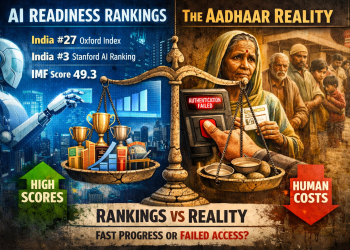


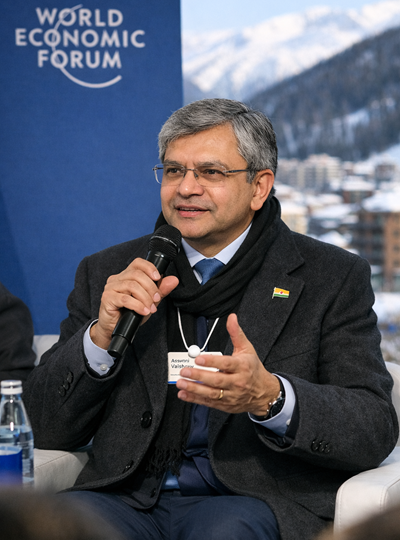
India’s IT Minister Ashwini Vaishnaw declared at the World Economic Forum this week that India is democratizing artificial intelligence by subsidizing AI infrastructure, deploying cost-effective sovereign models, training 10 million workers, and offering GPU compute access at one-third global rates, a strategy designed to challenge IMF rankings that place the country 72nd in AI readiness while positioning India as a first-tier AI power focused on accessibility rather than frontier model supremacy.
The minister’s insights, delivered during multiple Davos panels between January 20 and 22, directly challenged IMF Managing Director Kristalina Georgieva’s classification that placed India outside the top-tier AI nations.
Vaishnaw cited Stanford University’s AI Index, which ranks India third globally in AI penetration and preparedness and second in AI talent, to argue that multilateral institutions measure AI power incorrectly.
However, the real story lies not in the diplomatic clash but in India’s calculated bet that AI leadership in 2026 will be determined by deployment breadth, cost efficiency and economic impact, not by who builds the largest model.
The Democratization Doctrine and Making AI Affordable
At the heart of India’s strategy sits a public-private GPU pool of 38,000 graphics processing units, available to startups, researchers and students at INR 65 per hour, roughly one-third of global cloud GPU rates. This subsidy, funded through the INR 10,300 crore IndiaAI Mission, reduces the cost barrier that typically prevents emerging-market innovators from experimenting with AI at scale.
Vaishnaw said, “India has adopted a public-private partnership model to empanel GPUs as a shared national compute facility. Unlike many wealthy countries where big tech controls GPU access, this government-enabled and subsidized platform ensures students, researchers, and startups can all use high-end compute at roughly one-third of global costs.”
Moreover, India plans to launch indigenous sovereign AI models by February 2026 that will cost less than INR 100 per hour after a 40 percent government subsidy, compared to $2.50-$3.00 per hour for global commercial models.
Vaishnaw emphasized that these models, ranging from 20 to 120 billion parameters, can handle “nearly 95 percent of real-world use cases” without requiring the trillion-parameter architectures that dominate US-China competition.
“ROI does not come from creating the largest models,” Vaishnaw told WEF attendees, signaling India’s rejection of the parameter arms race in favor of efficient, domain-specific models tailored for enterprise deployment.
This approach fundamentally reshapes economics for Indian startups. While training a 6-billion-parameter model typically costs $23,594 per month in compute, India’s subsidized infrastructure and CPU-friendly sovereign models could reduce that figure by 60-70 percent, accelerating the prototype-to-production timeline.
The IMF Dispute and India’s Alternative Metrics
The tension between India and the IMF over AI rankings reflects a deeper philosophical divide about what constitutes AI leadership. The IMF’s AI Preparedness Index, which ranked India 72nd among 174 economies, weighs infrastructure readiness, regulatory frameworks, and human capital through a macro lens that favors mature economies with established computing infrastructure.
In response, India’s National Institute of Public Finance and Policy developed its own AI Composite Index, integrating patent filings, venture capital flows and deployment metrics to produce what officials call “policy-relevant insights”. This isn’t statistical manipulation; it represents India’s argument that AI power should be measured by diffusion, talent availability and economic productivity rather than raw infrastructure investment.
Consequently, Vaishnaw challenged Georgieva directly during a panel on AI governance, stating, “I don’t think your classification is correct.”
He pointed to Stanford’s Human-Centered AI Index, which uses deployment velocity, sectoral adoption and talent metrics—areas where India’s 5 million-strong tech workforce and rapid enterprise integration deliver strong performance.
Five-Layer Architecture: Building the Full Stack
India’s AI ambition extends beyond subsidized compute. The Indian IT Minister outlined a five-layer strategy covering applications, models, chips, infrastructure and energy, arguing that India is actively building capabilities across all layers simultaneously.
At the application layer, Indian IT services firms report that 74 percent of contracts signed over the past six quarters focus on AI-centric work, generative AI, agentic AI and machine learning, up from traditional digital transformation projects. HDFC Securities forecasts Indian IT services growth will accelerate to 7.7 percent in FY27, driven by enterprise demand for AI-enabled cost reduction.
Meanwhile, in the semiconductor layer, India has secured commitments for multiple fabrication plants expected to come online by late 2026, reducing dependence on foreign chip supply chains. Google’s $15 billion AI data center in Visakhapatnam and partnerships with IBM and Meta add foreign validation to India’s infrastructure push.
Furthermore, India’s 10 million-person AI skilling program aims to create the world’s largest AI-trained workforce, positioning Indian talent as the default integrator and operator of AI systems for global enterprises.
Governance Through Engineering
India’s regulatory approach diverges sharply from both the US’s laissez-faire model and the EU’s compliance-heavy framework. Vaishnaw advocates “techno-legal” governance, combining laws with technical safeguards such as deepfake detection tools, bias mitigation systems, and data “unlearning” capabilities.
“You cannot just pass a law and believe everything will fall in place,” Vaishnaw told WEF audiences. Instead, India is developing court-admissible deepfake authentication technologies through agencies like C-DAC, with regulations expected imminently.
This matters because India’s judiciary currently struggles with the authenticity of AI-altered evidence under the Information Technology Act, which presumes electronic records are genuine unless proven otherwise. This standard fails to withstand sophisticated manipulation. During elections, political parties must remove deepfake posts within three hours under Election Commission directives, creating demand for technical verification systems.
Additionally, Vaishnaw contrasted India’s approach with Europe’s: “The EU simply focuses on regulating things,” while India’s “bias is toward innovation,” combined with robust safeguards. For startups, this signals expect partly technical compliance obligations—certified detection tools, bias testing, logging systems—not merely documentary.
The $150 Billion Infrastructure Bet
India has secured $70 billion in confirmed AI infrastructure commitments, with expectations of reaching $120-200 billion by year-end as additional investments materialize. This capital flows into data centers, GPU clusters, semiconductor fabs and sovereign model development.
Critically, India plans to deploy 12 sovereign foundational models ranging from 50-120 billion parameters, designed to run on small GPU clusters or CPUs. Early testing shows “very encouraging” real-world performance, according to Vaishnaw, validating the mid-model efficiency thesis.
These models target specific verticals like healthcare, agriculture, governance, and climate change, where customization matters more than raw generality. For example, the IndiaAI Application Development Initiative approved 30 applications by July 2025, including the CyberGuard AI Hackathon for cybersecurity solutions.
What Founders and Investors Should Watch
India’s AI doctrine creates specific opportunities and constraints for founders, operators and investors:
First, subsidized compute fundamentally changes unit economics for Indian startups, reducing prototype-to-production costs by 60-70 percent compared to commercial cloud rates. This advantage persists only for entities with access to the national GPU pool; allocation criteria will become a critical gatekeeper.
Second, India’s mid-model strategy favors domain-specific, enterprise-focused AI companies over frontier research labs. Startups building vertical applications using 20-50 billion parameter models align perfectly with government infrastructure and subsidy programs.
Third, techno-legal regulation will require technical compliance capabilities, detection tools, bias audits, and logging infrastructure, creating demand for AI safety and governance startups.
Finally, India’s services-led orientation positions the country as the default AI integrator for global enterprises, particularly as 10 million workers gain AI skills, and Indian IT firms pivot toward AI-centric contracts.
The Accessibility Bet’s Strategic Trade-offs
India’s accessibility-first strategy carries clear trade-offs. While 38,000 GPUs constitute significant national infrastructure, the figure remains modest compared to the hundreds of thousands to millions operated by AWS, Google Cloud and Azure. India democratizes access domestically but doesn’t eliminate structural dependence on US hyperscalers for truly large-scale experiments.
Similarly, the mid-model focus optimizes for commercial deployment but risks ceding frontier research and the scientific breakthroughs that come with it to the US and China. If global AI capabilities bifurcate, with transformative general intelligence confined to trillion-parameter systems, India could find itself strong in application but dependent on foreign providers for cutting-edge tasks.
Nevertheless, Vaishnaw’s Davos performance signals India’s strategic choice: to compete on deployment, accessibility, and economic impact rather than on frontier-model supremacy. For emerging economies watching this experiment, India offers a playbook: democratize compute, target efficient models, build technical governance tools, and leverage services rather than chase Silicon Valley’s roadmap.
Stay ahead of the curve and follow IndiaTechDesk on Facebook, Twitter and Linkedin for in-depth news of market trends, funding updates, and regulatory changes affecting startups in India.
Read More:
- Wiom Raises $17 Million in Series A Round to Democratize Affordable Internet Access in India
- India Removes 3-Year Wait for Deep-Tech Startups to Get Govt Funds
- PM Modi Urges Focus on Real-World AI Impact, Says India Has No Time for ‘AI Toys’
- India Needs More Neutral Colocation Space for Supporting AI Startups
- Carzonrent Launches Plug Mobility, India’s First EV Mobility-as-a-Service Platform