

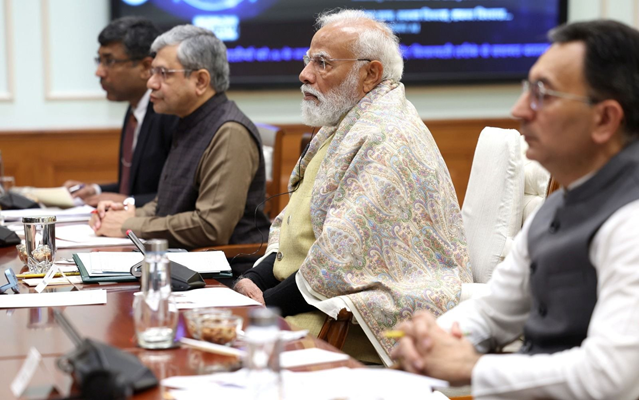
During a recent private meeting at his residence, Prime Minister Narendra Modi urged Indian AI startups to abandon “superficial AI toys” and instead focus on creating ethical and scalable foundation models reflecting India’s desire to reshape the global narrative around artificial intelligence, steering the conversation away from the profit-driven agendas of Western profit-first playbook.
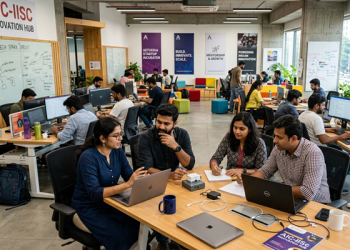
The roundtable discussion, held on January 8 with 12 carefully selected companies, including Avataar, Sarvam, Fractal, and Gnani.ai, comes at a time as India’s AI ecosystem raised frugal $643 million across 100 deals in 2025 when compared globally, a modest 4.1 percent increase that masks a strategic pivot toward application-led businesses over capital-intensive model development, according to Tracxn data.
At the same time, overall startup funding in India declined sharply, falling to between $10.5 billion and $11 billion in 2025, down from its peak levels. In response, the government is stepping in with a substantial $1.15 billion Fund of Funds and a $12 billion initiative for Research, Development, and Innovation to ensure that the AI ecosystem remains competitive on the global stage.
Government Bets Big on Homegrown Foundation Models
Prime Minister Modi’s recent message to startups at the India AI Impact Summit 2026 wasn’t just some diplomatic nicety; he stressed the importance of showcasing “Made in India, Made for the World” solutions. His call for innovations that prioritize data privacy, transparency, and support for regional languages directly challenge the dominance of English-centric models from companies like OpenAI and Google.
Union IT Minister Ashwini Vaishnaw, who was present at the summit, reiterated the commitment of INR 10,300 crore (approximately $1.24 billion) through the IndiaAI Mission, approved in March 2024. Notably, IIT Bombay received INR 988.6 crore ($119 million) specifically for developing a trillion-parameter foundation model.
This investment aims to bridge a critical gap in the Indian AI ecosystem. Historically, startups in this space have faced challenges securing late-stage funding. However, the government’s proactive move has already catalyzed nearly $2 billion in commitments from prominent investors like Accel, Blume Ventures, Celesta Capital, and Nvidia, which is advising on the matter. This demonstrates that state-backed initiatives can effectively attract private investment in emerging markets.
Still, there’s a real challenge on the horizon. Despite the surge in late-stage funding, early-stage AI investments took a hit, dropping by 37 percent in 2024. Investors seem to be playing it safe, looking for proven traction before committing their resources. The landscape remains tough for new startups eager to make their mark.
The 12 Startups Defining India’s AI Playbook
A diverse group of companies is driving India’s AI evolution, as showcased by the startups that Prime Minister Modi brought together for the meeting. For instance, Avataar specializes in creating generative 3D content tailored for e-commerce. Meanwhile, Sarvam and Gnani.ai are focused on developing multilingual large language models for India’s 22 official languages.
Fractal leverages AI for advanced analytics, particularly for Fortune 500 companies, while Tech Mahindra focuses on integrating AI into enterprise solutions. In the healthcare sector, Intellihealth is working on medical diagnostics, while startups like Genloop, Soket AI, Shodh AI, and Zeinteiq are tackling challenges in engineering simulations, speech-to-text technology, and materials research.
These Indian AI innovators have received backing from the IndiaAI Mission after showcasing their technical expertise. Earlier in the process, Gnani.ai, Sarvam, and Gan.ai made significant strides by securing early selections.
The September 2025 announcement added eight more candidates, including notable players such as Tech Mahindra and Fractal. It’s worth noting that Bengaluru startups led the funding race in 2024, though Hyderabad’s AI scene saw a notable rise, fueled by the Telangana AI Mission (T-AIM). This clearly shows how local initiatives can enhance broader federal programs.
Modi’s ‘Aatmanirbhar Intelligence’ Doctrine
At the meeting Modi rebranded artificial intelligence (AI) as “Aatmanirbhar Intelligence,” which translates to self-reliant intelligence and aligns with India’s economic nationalism campaign. His key directives indicate a strategic approach that goes beyond mere slogans.
Firstly, the Indian Prime Minister highlighted India’s cost advantages as competitive tools, encouraging startups to lead in “affordable AI” and “frugal innovation,” specifically tailored for emerging markets that are currently underserved by expensive subscriptions, such as the $20-per-month ChatGPT.
Secondly, he positioned trust, ethics, and unbiased algorithms as key differentiators, particularly in contrast to Western models, which are facing regulatory scrutiny over privacy violations and racial bias.
Thirdly, Modi stressed the importance of scalability. India processes 12 billion digital transactions per month through its Unified Payments Interface (UPI), demonstrating a deployment capacity that exceeds Silicon Valley’s.
Lastly, he urged startups to address local challenges, such as generating content in Indian languages, developing healthcare diagnostics for rural clinics, and developing agricultural AI solutions that run on feature phones rather than just smartphones like iPhones.
The Ecosystem’s Reality Check
Indian AI startups raised $780.5 million in 2024, a 39.9 percent increase from 2023. However, most of this funding went to late-stage companies like Kore.ai, Atlan, and Krutrim, leaving early-stage startups in a tight spot. Many founders were forced to bootstrap for longer periods, which delayed crucial research and development needed for breakthroughs that require significant computing resources over 18 to 24 months.
Currently, India’s AI startups are also competing against heavily funded state-backed companies in China and the vigorous venture capital landscape in the United States. The Indian government has allocated INR 551.75 crore (around $66 million) to the IndiaAI Mission for 2024-25.
However, this is peanuts when compared to China’s $50 billion investment and the over $100 billion from the US private sector. Additionally, Indian startups raised $1.48 billion across sectors in early 2025, highlighting the stiff competition for funding.
In closed discussions, startup founders acknowledged government support but pointed out serious market challenges. The influx of global AI labs setting up R&D centers in India is draining local startups of skilled engineers.
There are also significant infrastructure issues, such as limitations on accessing GPU clusters through the government’s subsidy program, which can take months, while private options like AWS are immediately available.
Lastly, some founders criticized Modi’s “Made in India” stance, arguing that successful AI companies need to develop core intellectual property locally but also leverage Silicon Valley’s distribution networks and sales expertise to secure Fortune 500 clients. This pragmatic approach aligns better with today’s commercial reality.
Strategic Implications for India’s Tech Sovereignty
India’s approach to AI is taking on a new dimension, as demonstrated by PM Modi’s recent roundtable discussions. The government is beginning to see AI as a crucial part of its geopolitical landscape rather than just a financial opportunity.
By supporting 12 foundation model developers, India aims to reduce its reliance on Foreign APIs and Chinese hardware, in line with its ambition for semiconductor self-sufficiency. The upcoming AI Impact Summit in February is set to be a major event, showcasing homegrown alternatives to platforms like ChatGPT and Gemini. This positions India as a reliable AI partner for countries in the Global South.
However, significant challenges lie ahead. The IndiaAI Mission, with its INR 10,300 crore budget, needs to be executed seamlessly across various sectors, including compute infrastructure, datasets, skill development, and startup financing.
Past tech initiatives have often faced bureaucratic hurdles, and avoiding these will be crucial. Additionally, the current environment for startup funding is tough; investors are leaning toward profitability rather than ambitious projects, which strains capital-intensive AI research.
On a more positive note, the Indian tech ecosystem is showing signs of maturity. There’s a noticeable shift towards late-stage funding, government support signaling quality, and more predictable exits for startups (despite limited data). Modi’s call for trust, ethical practices, and scalable business models resonates well, especially as sentiment towards Western AI becomes more critical.
For entrepreneurs, operators, and investors in India, the lesson is clear: India’s AI landscape may not mirror the Silicon Valley blueprint. Instead, it could carve out its own path, potentially slower and more closely tied to government support, while focusing on applications suited to emerging markets. These applications prioritize affordability and local language integration over cutting-edge performance.
Ultimately, the success of this vision hinges on how quickly capital is deployed, the retention of skilled talent, and how well startups can navigate the balance between nationalist ideals and practical business needs.
Stay ahead of the curve and follow IndiaTechDesk on Facebook, Twitter and Linkedin for in-depth news of market trends, funding updates, and regulatory changes affecting startups in India.
Read More:
- Wiom Raises $17 Million in Series A Round to Democratize Affordable Internet Access in India
- Travel Fintech Startup Scapia Bags $23 Million in its Series A
- Funding Winter Forces Indian Startups to LayOff Thousands Amid Economic Downturn
- Y-Combinator backed SaveIN Secures $8 million Over Nine Months
- Funding Winter Chills Indian Startups, Valuations Slide as Unicorns Dwindle