


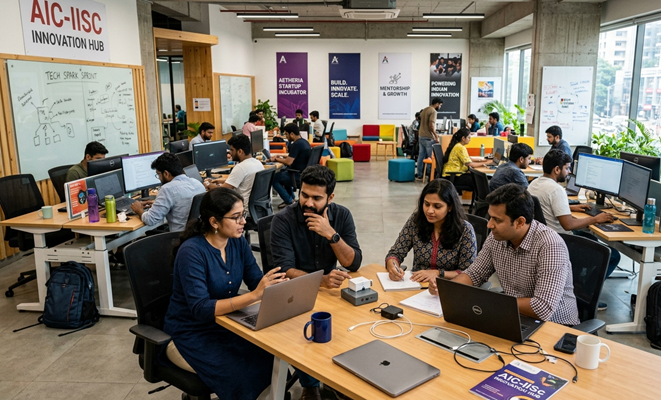
Every year, thousands of early-stage founders walk into incubation centres in India with raw ideas, borrowed laptops, and the quiet hope that someone in the startup support infrastructure knows how to help them build a company. Too often, the person greeting them has never built one.
This is the uncomfortable truth sitting at the heart of India’s startup support infrastructure, and it is time to name it plainly.
In this conversation with IndiaTechDesk, Mr. Vijay Bawra shares a grounded view of India’s fast-changing startup landscape and why incubation centres in India require a revamp, drawing on years of experience in startup innovation, incubation, partnerships, and ecosystem building.
Having worked closely with founders, mentors, investors, and emerging startup communities, he brings practical insight into how innovation is taking shape beyond the usual metro hubs. His insights offer readers a clear, on-the-ground perspective on entrepreneurship, early-stage ventures, and the forces shaping India’s next wave of startup growth.
The scaffolding is up. The substance is missing
According to Mr. Vijay Bawra, India crossed 2.1 lakh Department for Promotion of Industry and Internal Trade-recognised startups in 2025. Government programmes have seeded hundreds of incubation centres across universities and institutions. The intent is sound. The execution has a structural flaw that remains largely unspoken.
A significant proportion of these centres are led by academics whose primary qualification is institutional proximity rather than company-building experience. They can conduct workshops, evaluate pitches, and produce the documentation that unlocks the next tranche of funding.
What they cannot do is speak from experience. They have never negotiated a term sheet under pressure, made payroll from a line of credit, or shut down a product because the market did not respond. Founders sense this early. And quietly, they stop returning.
A tale of two mentors
Consider two scenarios that play out daily across India’s incubation ecosystem, he said.
In the first, a founder building a climate-tech solution for small and marginal farmers sits with an advisor, a knowledgeable, well-meaning agricultural economics PhD. The session produces a refined literature review of the sector and a suggestion to apply for three more grants.
The same founder sits with someone who spent seven years trying, and partially failing, to distribute solar irrigation equipment across Vidarbha. That person tells her which district officials move files, which distributor relationships matter, and why her pricing model will collapse in year two. The session saves her 18 months.
Both advisors care. Only one has been there. The difference is not academic qualification; it is scar tissue.
Why academia keeps getting this wrong
The university-housed incubator isn’t a bad idea in principle. The problem is how it gets staffed, adds Bawra. Academia values credentials- PhDs, publications, and administrative tenure.
What it rarely asks is whether that person has ever had to make a company work. The result is infrastructure built around what looks like support- demo days, hackathons, MoUs that rarely convert. The optics are strong. The outcomes, measured honestly, are weak.
Advising founders also tends to replicate the classroom hierarchy. The founder becomes a student, the advisor an evaluator. What a founder actually needs is a thinking partner who has felt the cost of bad advice themselves.
The tier-2/3 city compounding effect
This problem is serious in metro incubators. In smaller cities, it becomes a crisis. A founder in Ranchi, Coimbatore, or Guwahati faces a compounded disadvantage, says Bawra.
The local incubator is almost always theory-led, while experienced mentors remain concentrated in Bengaluru, Mumbai, or Hyderabad with no structured reason to engage elsewhere.
This is not a funding problem. Many of these centres are adequately resourced. It is a personnel and philosophy problem.
What the data should be asking
India’s policymakers have rightly made the startup ecosystem a national priority. But the metrics being tracked measure inputs, not outcomes. Counting sanctioned incubators and enrolled startups says nothing about what those startups became, he adds.
The honest question is: what percentage of companies completing an incubation programme achieve meaningful commercial revenue within 24 months? Of those that do, what kind of mentorship did they receive? And of the centres consistently producing those outcomes, who is actually running them?
The evidence points in one direction. Practitioner-led models work. Incubators run by people with operating experience, where mentors are chosen for judgment over titles, tend to produce founders who last.
A policy recommendation worth considering
According to Bawra, this is not an argument against academia. The argument is about who should be in the lead. The recommendation is specific: make verified operating experience a weighted criterion in funding incubation centres. Create pathways for experienced operators, including those from tier-2 cities, to lead at the national level.
The highest-performing incubation ecosystems globally share one trait. They are run by people who have built things, not merely studied them. India has no shortage of either. It simply needs to put the right one in the right seat.
The question that should keep us uncomfortable
While concluding, he said, we do not train surgeons under people who have only read about operations.
Yet we routinely ask India’s early-stage founders, at their most uncertain, to take direction from people who have never had skin in the game.
India has the ambition, the capital, and the talent to become a global innovation leader. What it needs now is the honesty to ask whether the people entrusted with nurturing that talent actually know what nurturing looks like.
Stay ahead of the curve and follow IndiaTechDesk on Facebook, Twitter and Linkedin for in-depth news of market trends, funding updates, and regulatory changes affecting startups in India.
Read More:
- PM Modi Urges Focus on Real-World AI Impact, Says India Has No Time for ‘AI Toys’
- Why India’s Water Crisis Needs More Than RO Purifiers
- India’s Gaming Empire on the Verge of Collapse After WinZO ED Raid
- India’s Interstate Rivalry Is Rewriting the Rules of Startup Funding
- Udaan Ramps Up B2B E-Commerce Play with $114M Series G Round