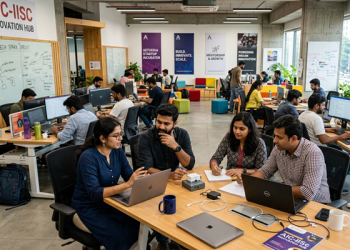



India’s startup ecosystem is at a historic crossroads, where AI disruption has triggered a sweeping funding collapse, exposing the fragility of sectors such as SaaS obsolescence, BPO decline, and the deepening EdTech crisis, which together signal the end of an era built on cheap labor and thin software layers.
Artificial intelligence, once seen as a ticket to success for startups, is now tearing apart the very business models that fueled India’s startup boom over the last decade. We’re witnessing a troubling shift: funding is dwindling, jobs are vanishing, and for five once-thriving sectors, the pressing question has shifted from how quickly they’ll grow to whether they’ll survive at all.
The statistics illustrate this harsh reality. In 2025, the number of startup funding rounds fell by 39 percent year-over-year, with only 1,518 deals, even as total capital raised remained around $11 billion, according to data. Venture fundraising hit a five-year low of $2.7 billion. In that same year, over 733 startups shut their doors for good. The Indian startup ecosystem isn’t merely recalibrating; it is facing a real reckoning.
The Five Sectors Gasping for Air
SaaS suffers AI Disruption
India’s vertical SaaS industry, once a pillar of strength of the startup ecosystem, now faces significant challenges driven by AI disruption. In the first nine months of 2025, funding for enterprise applications dropped by 6 percent. Between 2023 and 2025, a staggering 1,803 enterprise tech startups closed their doors.
It’s a harsh reality: consolidation is happening rapidly, but rather than a sign of vitality, it’s a clear indication of distress. In 2025, Indian SaaS companies completed 30 acquisitions totaling $386 million, but these deals primarily involved distressed assets rather than thriving businesses.
Sachin Parthiban, a SaaS founder, emphasized the slow decline of many SaaS companies, saying, “A lot of SaaS businesses are becoming irrelevant now, not overnight, but through a gradual shift as AI reshapes how we work.”
As this transformation unfolds, investors have become increasingly selective, directing their capital toward AI-native platforms that can completely overhaul workflows rather than enhance isolated tasks.
BPO: The $50 Billion Goodbye
India’s BPO decline is the most quantifiable human cost in this AI disruption story of the domestic startup ecosystem.
India has long been a leader in the global outsourcing market, controlling about 52 percent of it. However, this dominance may be at risk in the near future. A recent projection from investment bank Jefferies suggests that call-center revenues in India could drop by a staggering 50% over the next five years, as artificial intelligence takes over tasks once managed by millions of workers.
The job landscape in the Business Process Outsourcing (BPO) sector is changing dramatically. In the past, the industry welcomed around 130,000 new hires in 2022-23, but this number has dwindled to fewer than 17,000 annually over the last two years, according to reports.
Vinod Khosla, a prominent investor from Silicon Valley, noted in October 2025 that “all IT services will be replaced in the next five years,” describing the upcoming disruption as “pretty chaotic.”
Advances in AI technology mean that chatbots from companies like Haptik and LimeChat can now handle up to 95 percent of customer inquiries. This capability allows companies to reduce their workforce by up to 80 percent. For BPO startups that have relied on human labor in their business models, this shift could prove devastating.
IT Services: The Headcount Model’s Last Days
India’s IT services industry, which has grown to an impressive $280 billion, was built on a straightforward strategy: hiring large numbers of people and billing clients based on the number of workers involved. However, the rise of AI has disrupted this approach almost overnight.
Now, clients are looking for significant cost savings, around 20 percent, and the only way to achieve that is through automation as AI disruption hits. Wipro has cautiously estimated a 15-20 percent reduction in revenue from entry-level IT services as tasks such as quality assurance, testing, documentation, and data management are handled by AI. The market showed its concern in February 2026 when Indian IT stock valuations plummeted, losing $50 billion in just a week—the worst slide in almost six years.
On top of this, Indian startups that lack AI capabilities are facing serious challenges. As enterprise clients increasingly shift their focus from simply paying for workforce capacity to expecting tangible outcomes, these startups may struggle to survive in a rapidly changing landscape.
AI Wrappers: The Illusion of Innovation
The sharpest verdict stemming from the 2026 funding collapse targets a sector that once touted itself as the future: generic AI chatbot startups. In India, funding for AI startups fell by 53 percent from FY2023-24 to FY2024-25, from $305.9 million to $143.6 million.
Meanwhile, global AI funding skyrocketed to $110 billion in 2024, highlighting a striking contrast that is far from coincidental. This gap serves as a clear indictment; investors have become adept at separating genuine innovation from startups that merely repackage OpenAI’s API under a flashy brand.
Builder.ai, which had successfully raised $600–700 million from prominent investors, met its end in 2025, becoming a cautionary tale for a generation of startups that traded substance for hype.
Mid-year, four more Indian AI startups, including two backed by Y Combinator, closed their doors. As one popular analysis noted, “If your startup can be replicated at a weekend hackathon, you don’t have a business — you have a feature.”
EdTech: From Unicorn Dreams to 8-Year Funding Lows
The EdTech crisis serves as both a stark reminder and a valuable lesson for India’s startup ecosystem. In 2024, funding for EdTech plummeted 56 percent year-over-year to just $249 million – marking the lowest level in eight years. The number of deals also saw an 82 percent drop, from 172 in 2021 to 31 in 2024.
Once valued at $22 billion, BYJU’S is now navigating bankruptcy proceedings. Overall venture capital in the sector has fallen from a peak of $1.9 billion in 2020 to $536.7 million by 2024, according to Data.
The underlying issue is clear: AI-powered tutors now offer personalized, always-available instruction at a fraction of the cost of traditional recorded video courses or live online coaching.
“You can’t just import a global model and expect it to work in India,” says Dev Khare, a partner at Lightspeed Ventures. “What excites us is the shift from content delivery to more intelligent, personalized learning experiences powered by AI and data.”
Unfortunately, platforms that haven’t adapted to this shift find themselves with little excitement and no capital coming their way.
Why It Matters Now
India’s startup decade is built on five key sectors: labor arbitrage, software layers, and digitized content. Unfortunately, all three pillars are now facing significant challenges due to AI’s disruptive impact.
The recent downturn in funding isn’t just a minor adjustment; it’s a fundamental shift in how investors assess risk. Notably, SoftBank and Tiger Global made no investments in India in 2025. Additionally, seed-stage funding dropped by 12 percent compared to the previous year.
Currently, capital is directed toward AI infrastructure, deep tech, defense, and climate sectors, areas where results matter more than simply having a larger workforce. For founders who continue to rely on outdated models in these five sectors, investors have delivered a clear message: adapt or face extinction.
Stay ahead of the curve and follow IndiaTechDesk on Facebook, Twitter and Linkedin for in-depth news of market trends, funding updates, and regulatory changes affecting startups in India.
Read More:
- How this Shopify Accelerator Startup is Assisting New Consumer Brands to Become Top Favorites During the Pandemic?
- India Needs More Neutral Colocation Space for Supporting AI Startups
- Kalaburagi Startup Hub Marks Bold Shift in India’s Agri-Tech Entrepreneurship
- Deeptech Startups India, Can Policy and Capital Deliver?
- Zepto IPO Filing Signals Quick Commerce Battle Moves to Public Markets