


The Indian state of Karnataka launched its Centre for Entrepreneurship the Kalaburagi Startup Hub under the flagship Local Economy Acceleration Program (LEAP) initiative, marking a historic pivot toward rural innovation, agri-tech entrepreneurship, youth entrepreneurship, and a decentralized startup ecosystem across the state’s most underdeveloped regions.
The Kalaburagi Startup Hub, unveiled this week by Karnataka’s IT/BT Minister Priyank Kharge, represents the state government’s INR 1,000 crore, five-year commitment to spreading prosperity beyond Bengaluru, the startup capital of India.
Moreover, this initiative explicitly targets the Kalyana Karnataka region, comprising seven districts, including Bidar, Kalaburagi, Yadagir, Raichur, Koppal, Ballari, and Vijayanagar, which have struggled with economic stagnation despite constitutional protections.
Breaking the Bengaluru Monopoly
Karnataka dominates India’s startup landscape, hosting 50 percent of all funded startups nationwide and attracting $71.19 billion in venture funding between 2014 and 2024. However, this success remains concentrated in Bengaluru, leaving tier-II and tier-III cities starved of investment, infrastructure, and opportunities.
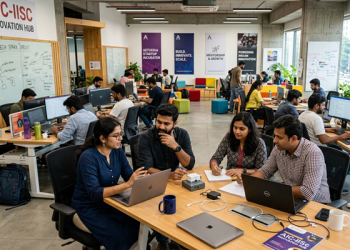
The LEAP initiative challenges this geographic monopoly by creating regional hubs designed to generate 500,000 jobs statewide. Consequently, the Kalaburagi Startup Hub serves as the cornerstone of this strategy, offering 15,000 square feet of plug-and-play workspace and a state-of-the-art Prototyping Lab.
“LEAP is not just an investment in startups—it’s an investment in building a balanced and equitable economic future for Karnataka,” Kharge said during the launch. The program aims to transform emerging clusters into self-sustaining, globally competitive innovation hubs.
Agri-Tech Takes Center Stage
The Kalaburagi Startup Hub will prioritize agri-tech entrepreneurship to address the critical challenges farmers face in a region where agriculture employs over 70 percent of the workforce. Furthermore, Karnataka already leads India in agri-tech startups, with companies deploying IoT-enabled crop advisories, precision farming tools, and blockchain-based supply chain solutions.
The centre has partnered with KrishiKalpa Foundation, a rural transformation organization that brings deep expertise in agricultural value chains. KrishiKalpa CEO CM Patil pledged to empower local youth and build an inclusive, future-ready entrepreneurial ecosystem.
“This collaboration will nurture young entrepreneurs and empower mission-driven founders in agriculture, allied sectors, and rural innovation,” KrishiKalpa CEO CM Patil said. The Prototyping Lab allows startups to design, build, and test innovations locally, dramatically reducing infrastructure and market-entry barriers.
The Kalaburagi Startup Hub employs a comprehensive three-pillar support system focused on mentorship, market access, and funding. Additionally, this framework provides incubation, acceleration, capacity building, and entrepreneurial development through targeted programs.
Karnataka Digital Economy Mission (KDEM) CEO Sanjeev Kumar Gupta said that LEAP will establish an integrated ecosystem blending deep tech, IT/ITeS, and agri tech. This integration drives regional growth and creates substantial employment opportunities.
The state government supports early-stage ventures through multiple funding mechanisms, including the Elevate Karnataka Programme, which provides one-time grants up to INR 50 lakh for proof-of-concept development. Furthermore, a dedicated INR 100 crore venture capital fund targets emerging sectors like artificial intelligence, machine learning, and robotics.
Youth Entrepreneurship and Inclusive Growth
Youth entrepreneurship forms the beating heart of the Kalaburagi initiative. The Kalyana Karnataka region possesses tremendous human capital, a young, dynamic population, but lacks the infrastructure, training, and funding to convert potential into prosperity.
The LEAP initiative will address this gap through entrepreneurship modules in schools and colleges, hackathons, bootcamps, and sector-specific Centres of Excellence. These programs provide end-to-end support to entrepreneurs at different stages of the startup lifecycle, from sparking curiosity in students to helping deep-tech companies access global markets.
Women entrepreneurs will receive special attention through direct loans of INR 10 lakh and a 25 percent reservation in venture capital funding. Rural innovators benefit from tailored funding programs, grants, and support for grassroots entrepreneurship.
Existing Founders Express Skepticism
Despite government optimism, existing entrepreneurs and startup ecosystem builders remain wary about the initiative’s actual impact. While Karnataka boasts successful models like the Deshpande Foundation in Hubli, one of India’s premier startup incubators with 440+ startups supported and Rs 120 crore in investments facilitated, the quality question persists.
Deshpande Foundation operates a 100,000 square-foot innovation facility with world-class prototyping labs through its Infinity Studio partnership, demonstrating what robust infrastructure looks like. Nevertheless, veteran ecosystem participants note that most startups emerging from tier-II cities in Karnataka remain novice ventures with limited scalability.
“Infrastructure alone doesn’t create quality startups,” observes a startup mentor who requested anonymity. “A 15,000 square-foot space and prototyping lab sound impressive, but without exceptional mentorship and deep domain expertise, they produce mediocre outcomes.”
Research on the implementation of Karnataka’s Startup India Programme reveals troubling gaps. A 2024 pilot study found that while financial assistance scored moderately (mean 3.45 out of 5), transparency in funding processes lagged significantly (mean 3.25).
More critically, mentorship quality received mixed reviews, with impact on scaling and business management strategies scoring only 3.29, suggesting highly variable mentor capabilities.
The Education Crisis No One Addresses
The fundamental issue politicians overlook is Kalyana Karnataka’s catastrophic education infrastructure crisis. The region’s 2024 SSLC results showed alarming declines, with Yadagir and Kalaburagi districts performing dismally compared to state averages.
More than half of all teaching positions remain vacant across the region. Of 23 pre-university colleges in Yadgir, only two have permanent principals. Guest lecturers handle just 12 classes per week, compared with 20 for regular faculty, and some teach at multiple colleges simultaneously. Critical subjects such as English, physics, chemistry, mathematics, and biology face severe teacher shortages.
Infrastructure deficiencies extend beyond staffing. Schools lack basic facilities, including functional toilets and drinking water, causing female students to leave during lunch and never return. Inadequate bus services provided by Kalyana Karnataka Road Transport Corporation prevent rural students from attending classes regularly, a problem that does not exist in better-performing regions.
“Despite Kalyana Karnataka’s special status and development board, progress is lacking,” stated Lakshman Dasti, founder of Kalyana Karnataka Horata Samiti. Activists point to teacher absenteeism, poor infrastructure, and systemic negligence from the education department as core problems.
The Industrialization-First Argument
Seasoned observers argue that Kalyana Karnataka requires massive industrialization and job creation before entrepreneurship initiatives can succeed. The region needs sustained per capita income growth, stable employment, and wealth accumulation across a generation or two before families can afford the risk inherent in startup ventures.
“You can’t expect entrepreneurship to flourish when people are struggling with basic livelihoods,” explains an industry veteran. “This region needs factories, manufacturing units, and formal sector jobs first. Entrepreneurship is a luxury that comes after economic security.”
The data support this view. Kalyana Karnataka’s per capita income lags significantly behind state averages, and industrial growth remains limited despite government incentives.
The 2002 Nanjundappa Committee identified 21 of Karnataka’s 28 most backward taluks within this region. Even with Article 371(J)’s constitutional mandate for special development, bureaucratic coordination failures and political hurdles have stalled meaningful progress.
The Kalyana Karnataka region endures a painful legacy of underdevelopment. Despite liberation 75 years ago, the area remains Karnataka’s least developed region, facing challenges in education, healthcare, infrastructure, and economic growth.
The region suffers from low agricultural productivity, inadequate irrigation, limited market access for farmers, and fragmented financing systems. These structural problems demand comprehensive solutions beyond startup hubs and prototyping labs.
Riding the Tier-II City Wave
The Kalaburagi Startup Hub capitalizes on a broader national trend. It is the rise of startups in tier-II and tier-III cities. Indian Cities like Jaipur, Indore, Lucknow, Kochi, Bhubaneswar, Coimbatore, and Chandigarh are now thriving startup communities.
These smaller cities offer distinct advantages, lower operating costs, access to untapped talent, and founders deeply connected to local problems. Startups here solve real challenges faced by India’s semi-urban and rural populations, from agri-tech platforms that improve crop yields to edtech solutions for small-town students.
Investors increasingly recognize that innovation extends beyond metropolitan hubs. Pre-seed funding flows more freely to tier-II cities as venture capital firms diversify portfolios and support founders addressing scalable, region-specific problems.
The Department of Electronics, IT, and Biotechnology has already invited proposals to establish Innovation Labs under LEAP, signaling rapid implementation. Quarterly reviews monitor progress on job creation and startup support through public dashboards and transparent citizen feedback forums.
The formal launch of expanded programs, including additional Innovation Labs, hackathons, and sectoral Centres of Excellence, is scheduled for January 2026. This timeline accelerates the region’s innovation journey and establishes accountability mechanisms.
Karnataka’s Startup Policy 2025-2030 complements LEAP by creating 25,000 startups across the state and providing state-of-the-art incubation centres, R&D hubs, and funding for early-stage ventures. The policy streamlines regulatory processes by simplifying compliance, providing single-window clearances, and fostering proactive engagement with authorities.
Hope Tempered by Realism
The Centre for Entrepreneurship in Kalaburagi represents an ambitious attempt at regional transformation through innovation-led growth. However, skepticism among existing founders and ecosystem builders reflects deeper truths about development priorities.
Without addressing foundational education quality, creating formal sector employment, and building robust industrial infrastructure, startup hubs risk becoming symbolic gestures rather than catalysts for change.
The Deshpande Foundation’s success in Hubli demonstrates that quality incubation is possible in tier-II Karnataka, but it requires decades of sustained investment, world-class facilities, and exceptional mentorship networks.
Whether Kalaburagi’s 15,000-square-foot hub with its Prototyping Lab can replicate that success, or whether it joins the long list of underutilized government infrastructure, depends on execution quality, mentor caliber, and, most fundamentally, whether policymakers address the education crisis and industrialization deficit that truly hold back Kalyana Karnataka.
For entrepreneurs in the region, cautious optimism mixed with wariness seems the appropriate stance as this INR 1,000 crore experiment unfolds.
Stay ahead of the curve and follow IndiaTechDesk on Facebook, Twitter and Linkedin for in-depth news of market trends, funding updates, and regulatory changes affecting startups in India.
Read More:
- How this Shopify Accelerator Startup is Assisting New Consumer Brands to Become Top Favorites During the Pandemic?
- India Needs More Neutral Colocation Space for Supporting AI Startups
- Retail Investors Rebel as India’s Tech IPO Hype Fades
- Early-Stage Founders Face Funding Crunch as 11,223 Startups Collapse in 2025
- Government’s INR 500Cr Lifeline for Indian Startups