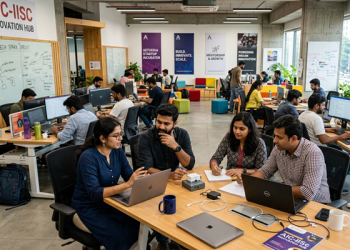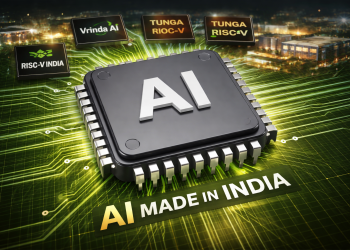



India startups celebrated crossing 200,000 registered ventures in December 2025. Yet a critical deep-tech funding drought threatens to stall the ecosystem’s evolution from consumer services to advanced manufacturing, exposing a structural divide in which fintech and e-commerce command 41 percent of capital. At the same time, semiconductors, quantum computing, and AI infrastructure struggle to attract patient investors.
The paradox emerged starkly during National Startup Day celebrations, when Indian Prime Minister Narendra Modi urged Indian startups to “focus more on manufacturing.” At the same time, venture capitalists reported that late-stage deep tech funding totaled only $345.5 million in 2025, less than one-third of the $971.9 million deployed at early stages, according to market data. This “valley of death” between proof of concept and commercialization at scale now represents the ecosystem’s defining challenge.
“What’s missing are large domestic funds that can back deep tech companies through multiple rounds and take them all the way to IPO,” Karthikeyan Madathil, partner at Yali Capital, told an Indian news outlet this month. “Startups still rely heavily on foreign capital beyond Series B and later stages.”
The 5% Problem, and Capital Concentration Blocks Strategic Sectors
While India startups generated 44,000 new registrations in 2025, the largest annual increase on record, deep tech ventures attract just 5 percent of ecosystem funding despite government commitments totaling INR 1 lakh crore ($11.4 billion) for semiconductors, quantum computing and AI infrastructure. By contrast, China deploys 35 percent of startup capital toward deep tech sectors, according to a comparative analysis.
Consequently, fintech commands 23 percent of India’s startup capital, e-commerce 18 percent, while quantum computing, advanced materials and semiconductor design ventures compete for scraps. This sectoral imbalance carries strategic implications: China invested $12.3 billion in AI and semiconductors alone during 2024, dwarfing India’s $1.6 billion total deep tech funding across all verticals.
Dr. Sunil Shekhawat of SanchiConnect identifies the root cause and said, “Without patient, mission-aligned capital, startups cannot sustain long R&D cycles or scale globally. Legacy funding models still prioritize quick returns over deep innovation.”
Regulatory Bottlenecks Compound Capital Scarcity
Deep tech funding gaps intensify due to regulatory delays plaguing government schemes. The Fund of Funds for Startups deployed INR 25,320 crore through alternative investment funds since 2016, yet only INR 3,200 crore, 32 percent of the original corpus, reached actual ventures, government data reveals.
Meanwhile, Fund of Funds 2.0, approved in April 2025 with INR 10,000 crore earmarked specifically for deep tech, remains without implementation guidelines nine months later.
“Some portfolio companies received grants nearly two years after applying, by which time they no longer needed the cheque,” one investor said to IndiaTechDesk. This bureaucratic friction particularly damages capital-intensive deep tech ventures operating on tight runway projections.
Rishabh Bardia, vice president at Premji Invest, who looks after emerging solutions, said, “If we can build conviction early around a founder, a problem and the technology, we can step in early and support companies through multiple stages.” Premji Invest now backs early-stage funds explicitly designed to bridge gaps in India’s deep-tech startup pipeline.
India Startups Infrastructure Void
Beyond capital scarcity, Indian startups face infrastructure deficits that prevent deep-tech scaling. Limited access to advanced testing labs, prototyping facilities and fabrication infrastructure leaves 60 perent of ventures under-equipped.
Public institutions rarely share specialized equipment, forcing startups to either invest in redundant infrastructure or outsource critical development abroad, both of which destroy unit economics.
India’s quantum computing roadmap, released in December 2025, candidly acknowledges “heavy import dependence for cryogenic components, superconducting materials and optical assemblies,” alongside talent shortages in specialized domains such as cryogenics and microwave engineering.
The roadmap targets 10 globally competitive quantum startups generating $100 million in cumulative revenue by 2035, yet achieving this requires infrastructure investments that have not yet been committed.
Semiconductor ventures face similar constraints. Despite government incentives worth INR 76,000 crore and four fabrication projects approved, venture capital funding for chip design startups remains “modest,” industry experts note, citing the capital-intensive nature and 7-10-year commercialization cycles that conflict with typical fund lifecycles.
The China Comparison
India’s deep tech ambitions confront uncomfortable comparisons. China’s total R&D spending reached $496 billion in 2024, while India allocated INR 20,000 crore ($23.45 billion) to the Department of Science and Technology.
Moreover, India commercializes just 15 percent of its 82,811 annual patents compared with Israel’s 90 percent rate, highlighting not invention gaps but execution failures in translating research into market-ready products.
“We often want Silicon Valley valuations, but we haven’t fully internalized Silicon Valley execution,” Madathil observed. “Exposure to global capital forces founders to operate at that level, which is critical if they want to compete internationally.”
Vishesh Rajaram, co-founder at Speciale Invest, frames the adaptation challenge differently. “Deep tech doesn’t change to fit venture capital. Venture capital has to adapt and learn,” he added.
His firm raised an INR 1,400 crore growth fund specifically targeting Indian startups navigating the lab-to-production valley of death.
Geographic Promise Meets Infrastructure Reality
Tier-II cities now account for 50 percent of India’s startup formations, with Jaipur recording 5,060 registrations in 2025. However, this geographic decentralization primarily drives consumer services and basic software sectors that require minimal infrastructure. Deep tech ventures that require clean rooms, electromagnetic testing facilities, and materials science labs remain concentrated in metros where such infrastructure is available.
Women entrepreneurs achieved remarkable gains, leading or co-leading 45-48 percent of Indian startups and raising $930 million in 2024-25 (a 94 percent surge). Nevertheless, female founders remain underrepresented in deep-tech verticals, where access to infrastructure and network effects favor established metro players.
The Manufacturing Imperative and Quality Reset
India’s 125 unicorns have a combined valuation of $366 billion, maintaining the country’s position as the world’s third-largest startup ecosystem. Still, only six companies achieved unicorn status in 2025, versus 45 in 2021, an 87 percent decline reflecting investor discipline that demands profitability over hypergrowth. Dhan’s unicorn achievement while maintaining profitability exemplifies the new standard.
Modi’s National Startup Day speech made manufacturing priorities explicit, signaling government recognition that consumer internet scaling cannot deliver technological sovereignty. The INR 1 lakh crore Research, Development and Innovation scheme targeting AI, semiconductors and defense technologies represents this strategic pivot.
However, execution remains the litmus test. Government targets call for 1 million India startups by decade’s end, yet observers emphasize: “The quality of entrepreneurship matters more than quantity.”
The next phase for India startups require structural reforms: faster government grant disbursement, patient domestic capital pools spanning 10-year horizons, shared infrastructure to reduce redundant investments, and talent pipelines to address specialized skill shortages.
Without these foundations, Indian startups risk remaining a consumer services platform rather than evolving into the deep-tech manufacturing hub that 200,000 registered ventures and 2.1 million direct jobs promise to become.
The next few months will reveal whether DPIIT’s pre-budget lobbying translates into meaningful policy action, or whether India’s early-stage founders continue to navigate an institutional desert while watching growth-stage peers capture billions.
Stay ahead of the curve and follow IndiaTechDesk on Facebook, Twitter and Linkedin for in-depth news of market trends, funding updates, and regulatory changes affecting startups in India.
Read More:
- Pocket FM Raises $103 Million in Series D Funding for Global Expansion
- Infinite Uptime Raises $35M to Revolutionize Predictive Maintenance in Manufacturing
- Flipspaces Secures $50 Million in Series C Funding to Expand Interior Design Tech
- Spyne Secures $16 Million to Drive AI-Powered Automotive Retail Expansion
- Airmeet Introduces New Networking Features to Drive Engagement in Virtual Conferences