

India’s Auto PLI scheme, long crippled by eligibility thresholds that shut out fledgling EV startups, now faces its most serious political challenge yet, as a parliamentary panel demands that the government open the door to electric small Indian two-wheeler pioneers and reboot the INR 25,938 crore manufacturing experiment.
The Parliamentary Standing Committee on Industry tabled a report in the Rajya Sabha on March 11, calling for “calibrated flexibility or differentiated eligibility criteria,” a verdict that lands hard on five years of a program that has disbursed less than 10 percent of its total budget while leaving India’s most innovative EV builders outside looking in.
For context, India’s Production-Linked Incentive (PLI) scheme for the automobile and auto components sector was launched in 2021 with a budgetary outlay of INR 25,938 crore to catalyse investment in advanced automotive technologies, including electric vehicles (EVs), and to create a globally competitive manufacturing base.
While the scheme has attracted sizeable investment commitments and some disbursals, design choices, especially high entry thresholds, a one-time application window, and rigid performance conditions, have systematically excluded most EV-first startups, concentrating benefits among large incumbents and a handful of well-capitalised new entrants such as Ola Electric.
However, this is set to change.
The Advocacy That Moved the Needle
Over the past year, the Startup Policy Forum, a coalition of over 50 innovative tech companies, has actively pushed for change. They’ve gathered extensive data to highlight how high eligibility thresholds have excluded many of their members from government support.
With this evidence in hand, they crafted a detailed representation to the Prime Minister’s Office, urging the Ministry of Heavy Industries to adopt a multi-window entry framework. This system would allow slots abandoned by underperforming PLI beneficiaries to be reassigned to agile EV startups, rather than leaving them vacant.
Ather Energy, one of the key voices in this advocacy, raised concerns in December 2024, stating that the scheme was primarily benefiting large corporations. They pointed out the risks of market monopolization and the vulnerabilities these create within the electric two-wheeler supply chain.
Just weeks later, the Parliamentary committee issued a report that seemed to directly address these issues, illustrating how effective, data-driven lobbying can influence an INR 25,938-crore manufacturing program from the outside.
Tarun Mehta, Co-founder and CEO of Ather Energy, emphasized the need for policy evolution, such as the Auto PLI, if India aims to establish a competitive EV ecosystem. He noted that the recommendations from the Standing Committee represent a positive step forward.
He said, “Many Indian EV startups are already at the forefront of cutting-edge technology and heavily investing in research and development. By creating a more inclusive framework, the country can foster innovation, develop indigenous intellectual property, and enhance advanced manufacturing capabilities right here in India.”
A Scheme Built for Yesterday’s Winners
When the government designed the Auto PLI scheme, it installed entry barriers calibrated for boardrooms in Mumbai and Chennai, not startup offices in Bengaluru. Existing automotive OEMs needed a global group turnover of at least INR 10,000 crore and fixed-asset investments of INR 3,000 crore. These eligibility thresholds effectively told every EV startup in the country: come back when you’re bigger.
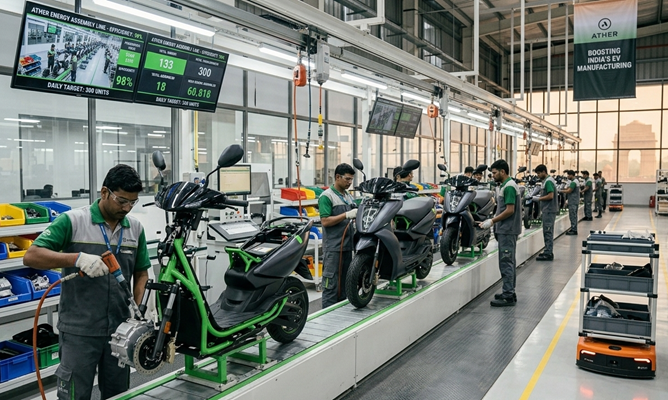
The result was a winner’s table dominated by legacy names. Close to 70 vehicle variants from just three companies, Mahindra & Mahindra, Tata Motors, and Bajaj Auto, qualified for incentives. Meanwhile, Ather Energy, one of India’s fastest-growing electric two-wheeler makers, remained locked out despite building locally engineered vehicles from scratch and betting heavily on manufacturing in India from day one.
As of December 2024, only 12 out of 82 approved applicants, fewer than 15 percent, had met the mandatory 50 percent domestic value addition (DVA) requirement. Another 12 failed their initial two-year investment obligations. In short, the scheme often underperformed. Yet the seats stayed taken.
Shweta Rajpal Kohli, President & CEO, Startup Policy Forum, told IndiaTechDesk, “The government’s Production-Linked Incentive (PLI) scheme has played a crucial role in strengthening India’s manufacturing ecosystem, boosting domestic production, and enabling companies to scale globally. However, the eligibility thresholds, particularly under the auto segment, have not fully aligned with the realities of emerging startups, leaving many innovative players unable to access its benefits.”
The Ola Loophole — and Its Lessons
Not every startup was shut out, however. Ola Electric found a side door.
The scheme offered an alternative route for “new non-automotive investors” requiring a group net worth of INR 1,000 crore, with no automotive turnover needed. Backed by major investor capital, Ola cleared this bar and entered as one of only 18 approved Champion OEMs, alongside Tata Motors, Hyundai, and Bajaj Auto.
That strategy paid off. In December 2025, Ola received a sanction order for INR 366.78 crore in Auto PLI scheme incentives for FY 2024-25 alone, making it one of the largest single-year EV beneficiaries in the program’s history.
However, Ola’s journey carries a warning. Under the separate FAME-II demand-subsidy program, the company agreed to reimburse roughly INR 130 crore after investigations found it had billed off-board chargers separately, an apparent workaround to keep vehicle prices below the INR 1.5-lakh subsidy cap.
Other OEMs faced larger penalties for importing components while claiming subsidies meant to reward domestic production. Together, these episodes make one thing clear: broadening the Auto PLI scheme for EV startups must come with sharper compliance design, not loosened oversight.
The Parliamentary Verdict
The March report from the committee does more than just confirm startups’ concerns; it points to a fundamental issue with the current eligibility criteria. By linking eligibility to the size of balance sheets rather than to innovation, the government effectively created a subsidy system that favors established companies. These firms, which already possess the required turnover, assets, and distribution capabilities, dominate the landscape.
Key observations from the Parliamentary Panel highlight that the current eligibility thresholds may be barring emerging EV startups from participating in opportunities. They emphasize the need for more flexible criteria, especially for the electric two-wheeler (e2W) sector.
Additionally, frequent downward budget revisions suggest that initial allocations may have been overestimated or that scheme implementation is slower than anticipated.
To address these issues, the Parliamentary Panel recommended establishing a high-level mechanism to monitor the growth in capacity, sales, and certification. They also urged resolving sector-specific challenges, particularly the eligibility rules that exclude domestic startups.
This report signals a small yet significant step forward, aligning with what the Startup Policy Forum (SPF) has repeatedly brought to policymakers’ attention. Ather Energy shed light on this contradiction in a formal submission to the Prime Minister’s Office.
They cautioned that the Production-Linked Incentive (PLI) benefits have primarily benefited large players, relegating startups to mere Tier-II and Tier-III supplier roles. In response, Ather proposed a dynamic “multi-window” framework in which slots freed by underperforming beneficiaries could be reallocated through fresh bidding, similar to the more adaptable Advanced Chemistry Cell (ACC) battery PLI model.
The parliamentary panel agreed. It is recommended that the Ministry of Heavy Industries directly address the eligibility thresholds excluding domestic startups through “calibrated relaxations, while maintaining fiscal safeguards.”
What Happens Next — and Why It Matters
If the government takes action, the manufacturing sector will see an immediate and measurable impact. Companies like Ather Energy, River, and Euler Motors, which have invested nearly INR 1,500 crore in electric two-wheeler production despite not meeting the PLI requirements, stand to benefit significantly. They could gain access to multi-year production-linked incentives that would help safeguard their major investments.
By including small EV startups in the Auto PLI scheme, we could diversify the supply chain and reduce the risks associated with concentrating industrial-policy benefits among a few large, vertically integrated companies. This move would signal that India’s manufacturing strategy values innovation just as much as it does size and legacy.
Time is of the essence. With the March 2028 deadline approaching and previous disbursements taking longer than expected, we need to act quickly. The electric two-wheeler segment underscores the urgency; EV startups have consistently outperformed traditional manufacturers in technology and in earning consumer trust. Currently, EV penetration in two-wheelers sits in the mid-single digits, a long way from India’s 2030 targets.
Ather Energy and its fellow startups, which have been excluded due to outdated eligibility criteria, embody the manufacturing ambition India claims to pursue. The parliamentary committee has made its case loud and clear.
Stay ahead of the curve and follow IndiaTechDesk on Facebook, Twitter and Linkedin for in-depth news of market trends, funding updates, and regulatory changes affecting startups in India.
Read More:
- PM Modi Urges Focus on Real-World AI Impact, Says India Has No Time for ‘AI Toys’
- India Chooses Scale Over Supremacy in Global AI Race
- India Deep Tech Startups Face $626M Funding Drought
- India’s AI Brain Drain and Deeptech Boom Are Happening at the Same Time
- India Becomes the First Major Economy to Regulate Deepfakes