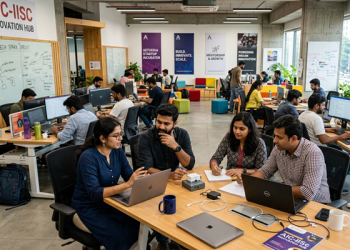



Uttar Pradesh, officially India’s fourth-largest startup ecosystem since 2023, has 18,568 active startups across all 75 districts, powered by strong funding policies and a surge of women-led ventures in tier-2 cities that is beginning to challenge Bengaluru’s long-standing hold on the nation’s innovation economy.
Moreover, this rapid expansion places the northern state behind only Maharashtra (26,000+ startups), Karnataka (21,000+), and Delhi in total venture count, but ahead in year-over-year growth velocity, adding more than 4,500 new companies between March and December 2025 alone. Consequently, the state government’s INR 1,000 crore UP Startup Fund and 63 incubation centers have manufactured at scale what traditional tech hubs took generations to build organically.
Meanwhile, nearly 8,000 of the 18,568 startups currently registered are led by women, representing 43 percent of the Uttar Pradesh startup ecosystem, triple the national average of 14 percent recorded in previous government assessments. Additionally, this concentration of female founders creates the largest absolute cohort in any Indian state, fundamentally altering who builds companies and where they choose to establish operations.
Furthermore, the distribution spans cities previously invisible to venture capitalists, such as Gorakhpur, Prayagraj, Varanasi, and Kanpur, which now host functioning incubation facilities alongside established hubs Noida and Lucknow. Therefore, tier 2 cities are capturing entrepreneurial talent that historically migrated to Mumbai or Bengaluru, reversing brain drain patterns that defined India’s economic geography for fifty years.
Policy Infrastructure Replaces Organic Growth Model
Chief Minister Yogi Adityanath-led administration deployed industrial-scale policy intervention to accelerate the Uttar Pradesh startup ecosystem, offering interest-free loans up to INR 5 lakh under the Mukhyamantri Yuva Udyami Yojana, with over 32,000 young entrepreneurs already receiving sanctioned capital.
Similarly, the state provides 100 percent stamp duty exemptions on land purchases and five-year electricity duty waivers to reduce operational costs to levels below those of tier 1 cities.
Meanwhile, 76 incubation centers across 23 districts now provide mentorship, technical support, and workspace infrastructure that traditionally required proximity to established accelerators in Delhi-NCR or Bengaluru. In contrast, Karnataka’s ecosystem developed over three decades through organic market forces, while UP compressed the timeline to under eight years through deliberate capital allocation.
Unlike the fintech and e-commerce saturation characterizing the portfolios of Mumbai and Bengaluru, the Uttar Pradesh startup ecosystem focuses on agritech, artificial intelligence, drones, medtech, blockchain, quantum computing, and space technology, sectors aligned with future industrial cycles rather than current consumer trends.
Subsequently, startups addressing agricultural productivity leverage the state’s farming economy while AI and drone ventures target defense logistics and manufacturing automation, where UP maintains infrastructure advantages.
Notably, this sectoral diversification positions companies to serve enterprise customers and government contracts rather than compete in crowded consumer markets dominated by established players. Hence, the 18,568 startups collectively pursue differentiated growth paths unavailable in markets where hundreds of rivals chase identical opportunities.
Capital Allocation Faces Structural Redistribution
Historically, Bengaluru has captured 36 percent of India’s total startup funding since 2014 ($72 billion), with Delhi-NCR and Mumbai accounting for an additional 40-45 percent of venture capital deployed nationally. However, tier 2 cities now account for 45 percent of India’s total startups while receiving less than 10 percent of available startup funding, a structural imbalance that UP’s ecosystem growth directly challenges.
Consequently, early-stage venture firms like India Accelerator actively scout beyond metropolitan boundaries, recognizing that customer acquisition costs and regulatory complexity decrease substantially outside tier 1 markets. Nevertheless, access to follow-on capital remains concentrated in traditional hubs, creating a “funding cliff” where tier 2 cities excel at company formation but struggle to scale past Series A rounds.
By March 2025, Uttar Pradesh ranked third nationally with over 14,000 registered ventures and 26 unicorns, according to the government’s Startup Ecosystem Report. Then, between March and December, the state added 4,568 startups, demonstrating month-over-month acceleration exceeding those of established ecosystems like Tamil Nadu (8,583 total) and Telangana (approximately 1,800).
Comparatively, this growth rate mirrors Israel’s rapid ecosystem expansion during the 1990s, when government-backed venture funds and military technology transfer programs created the “Startup Nation” framework now studied globally. Similarly, Singapore’s transformation from a manufacturing hub to an innovation center required coordinated policy support, infrastructure investment, and talent development—the exact playbook UP currently follows.
District-Level Penetration Creates Hyper-Local Solutions
Unlike Bengaluru’s concentration in Whitefield and Electronic City or Delhi-NCR’s clustering in Gurugram and Noida, the Uttar Pradesh startup ecosystem operates across all 75 districts simultaneously, a geographic distribution unprecedented among India’s major innovation centers.
Therefore, startups in Basti, Bareilly, and Bahraich address rural fintech, vernacular commerce, and agricultural supply chain challenges that metro-based founders rarely encounter.
Moreover, this district-level penetration ensures that local problems receive dedicated entrepreneurial attention rather than one-size-fits-all solutions designed for urban markets. Accordingly, women entrepreneurs in smaller cities build businesses around community needs they understand intimately, creating sustainable models that venture capital often overlooks in pursuit of billion-dollar exits.
Engineering graduates from IIT-BHU Varanasi, MNNIT Allahabad, and Harcourt Butler Technical University historically migrated to Bengaluru or Gurugram immediately after graduation, draining UP of technical talent. Now, the state’s expanding startup funding infrastructure allows graduates to access comparable opportunities without relocating, retaining economic value within local communities.
Additionally, the remote-first work culture adopted during the pandemic normalized distributed teams, eliminating the geographic arbitrage that previously required physical presence in tier 1 cities to access top-tier opportunities. Thus, talent concentration, historically Bengaluru’s competitive moat, becomes less relevant when startups operate asynchronously across multiple locations.
Investment Community Adapts to New Geography
Micro-VCs and state-backed funds now actively source deals in tier 2 cities, recognizing that unit economics and distribution advantages often favor non-metro startups despite smaller initial market sizes.
Similarly, corporate venture arms evaluate companies based on technology moats and repeatability rather than headquarters location, reducing the “big city premium” that once determined valuation multiples.
Ultimately, the emergence of the Uttar Pradesh startup ecosystem validates the idea that deliberate policy intervention can create innovation hubs in geographies previously written off as manufacturing centers or agricultural economies.
Whether this model proves replicable across India’s remaining states, and whether tier 2 cities overcome the funding cliff to produce billion-dollar companies, will determine whether UP’s growth represents a temporary redistribution or a permanent geographic rebalancing of India’s innovation economy.
Stay ahead of the curve and follow IndiaTechDesk on Facebook, Twitter and Linkedin for in-depth news of market trends, funding updates, and regulatory changes affecting startups in India.
Read More:
- How this Shopify Accelerator Startup is Assisting New Consumer Brands to Become Top Favorites During the Pandemic?
- India Needs More Neutral Colocation Space for Supporting AI Startups
- Retail Investors Rebel as India’s Tech IPO Hype Fades
- Early-Stage Founders Face Funding Crunch as 11,223 Startups Collapse in 2025
- Government’s INR 500Cr Lifeline for Indian Startups