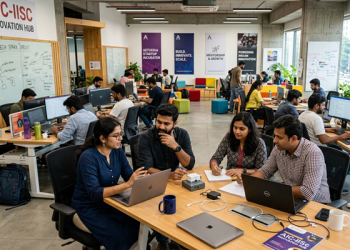



AI startups in India will receive a significant boost as the country’s digital infrastructure expands, with increased data center capacity, advanced Edge Data Centers, and a stronger Mumbai Data Center Hub, thanks to the Indian government’s tax exemption policy.
The country will double third-party Data Centre capacity from roughly 1,250 MW to about 2,400–2,500 MW by FY2028. That surge will change how founders design, train and scale AI products.
Investors and operators will pour nearly INR 90,000 crore into the next phase of growth, unlocking significantly more data centre capacity, according to a report by the Indian credit rating agency (ICRA).

As a result, AI startups will gain faster, lower-cost access to racks equipped for model training and inference. Industry planning already points to a multi-year buildout that could expand total installed capacity to multiple gigawatts over the next decade.
From prototypes to production
First, the larger pool of compute will shorten the path from prototype to production. When data centre capacity expands, founders can run more experiments in less time and at a lower cost.
Consequently, AI startups will move beyond toy models and deliver real services to sectors such as finance, healthcare, and agriculture. This shift will encourage new product architectures that assume local, high-density compute is available nearby.
Second, the rise of edge data centers will enable companies to deploy latency-sensitive AI closer to users. Edge data centres reduce round-trip delays and make real-time inference practical for telemedicine, industrial monitoring and autonomous systems.
Hence, startups building time-critical apps will design hybrid models that run lightweight checks on-device and call edge nodes for more intensive inference.
Why Mumbai matters?
Third, Mumbai’s role as a data centre hub gives startups a regional advantage in terms of connectivity and peering. The city already handles a majority of the country’s operational capacity, and this concentration helps firms with international pipelines and access to submarine cables. Startups that colocate or partner in the Mumbai data centre hub will benefit from lower latency to primary cloud services and denser enterprise demand.
Finally, a pending tax exemption policy could alter the economics of building and running data centres. The draft National Data Centre Policy proposes incentives, including long-term tax breaks and GST input credits, on capital investments. If authorities finalize the tax exemption policy, developers could lower capital costs and pass the savings on to customers, which would reduce fixed infrastructure spending for AI startups.
Better infrastructure will change engineering trade-offs. Teams will rely more on distributed training, experiment with larger models, and use data locality to comply with regulations. When data centre capacity becomes abundant and predictable, startups will stop overprovisioning and instead adopt pay-as-you-grow contracts. That approach keeps burn under control while enabling aggressive product iteration.
Operators plan to increase renewable sourcing for data centres as they scale. The growing share of green power will enable startups to measure and improve the carbon intensity of their training runs. Therefore, companies that prioritize sustainability can highlight lower scope-2 emissions and attract customers and investors who care about environmental performance.
Meanwhile, market competition will tighten margins even as capacity grows. Developers have funded expansion with long-tenured debt, and analysts expect leverage to remain elevated in the medium term. Thus, startups should expect improving but still disciplined pricing from operators, and they should plan capex and opex assumptions accordingly. In practice, founders should insist on flexible terms and staged commitments to avoid locking in unfavorable rates.
Opportunity map for AI startups
- Model training and tooling: New GPU clusters in third-party centres will enable startups to train larger models and to provide model-as-a-service offerings.
- Real-time inference: Edge data centers will enable firms to offer low-latency APIs for sectors that cannot tolerate delays.
- Enterprise adoption: Firms working with banks and hospitals will reduce legal friction by keeping data and computing inside India.
- Cost and sustainability: Startups can adopt carbon-aware training schedules and seek partners that source renewable energy.
Practical moves for founders
Founders should negotiate pilot credits with local data centre operators and require transparent SLAs for GPU availability. They should design modular pipelines so workloads shift between on-prem, local DCs and public clouds without code rewrites.
Likewise, teams should appoint a compliance owner and document consent and provenance for training datasets to meet evolving rules. Finally, they should monitor the progress of the tax exemption policy, as the final design could influence long-term pricing and location choices.
Globally, India accounts for a small but growing share of total installed capacity, roughly 3 percent of an estimated 42 GW worldwide. The United States still supplies around half of that amount. Still, India’s expansion could accelerate the country’s standing in the digital economy. As capacity increases, cross-border latency will decrease for some services, allowing local startups to access global markets with fewer infrastructure hurdles.
Anupama Reddy, Vice President and Co-Group Head, Corporate Ratings, ICRA, said: “The recent draft proposal of the Ministry of Electronics and Information Technology (MeitY) to provide a 20-year tax exemption policy, if implemented, could be a game-changer for India’s data centre growth prospects. By offering input tax credits on capital investments like construction and electrical systems, the policy aims to lower upfront costs and improve project viability.”
“This long-term incentive is expected to attract significant domestic and global investments, enabling developers to scale operations with greater confidence. With coordinated efforts to ensure a reliable power supply and strategic land allocation, the initiative aligns with India’s vision of becoming a global digital leader and achieving its trillion-dollar digital economy goal,” added Reddy.
Stay ahead of the curve and follow IndiaTechDesk on Facebook, Twitter and Linkedin for in-depth news of market trends, funding updates, and regulatory changes affecting startups in India.
Read More: