

From the Ganga’s relentless currents to the trust a Bengal-based startup is building, one robot at a time, the deep-tech journey of Banergy shows how Indian conditions and local challenges are shaping the future of robotics and deep tech for the world.
American ocean engineers test underwater robots in the Pacific Ocean, where depths of 40–50 meters bring stable, predictable water columns. But when Swarnab Banerjee brought that same technology to India’s Ganga River, it failed spectacularly.
“The entire water column was moving,” says Swarnab Banerjee, operations lead at Banergy, a Kolkata-based marine robotics startup. “Still water affects it, but a flowing river current? That’s completely different.”
From these challenges emerged India’s first indigenous underwater robots designed specifically for the world’s most unforgiving freshwater environments. What began as a family’s attempt to revive a 50-year-old manufacturing legacy is now slowly evolving into a deep-tech bet that could redefine where frontier innovation originates.
From Factory Floors to Riverbeds, A Three-Generation Pivot
The Banerjee family’s factory in Bakura dates to 1973, producing rubber, metal, and plastic components for India’s industrial base. Swarnab, educated in Kolkata before moving to the US, returned after 18 years abroad with an electrical engineering degree and three startups under his belt.
“My father was a first-generation businessman,” Swarnab said. “After he passed away in 2015, I had to go through a lot of changes.”
His first Indian venture, electric motors for EVs in 2012, collapsed because the ecosystem wasn’t ready. “People didn’t believe me then,” he said. “I learned from that failure.”
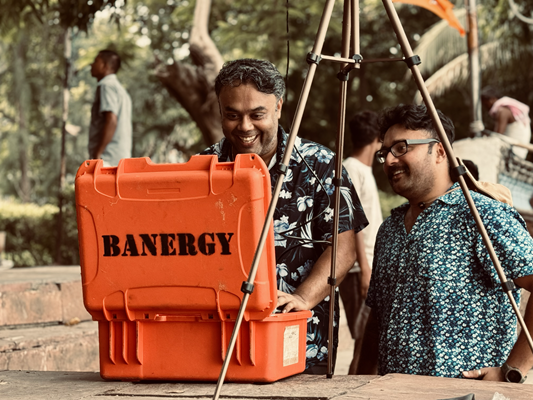
The lesson stuck. In 2024, when his younger brother Rishav Banerjee returned from America with expertise in underwater robotics, Swarnab didn’t just start building robots. They began nurturing an ecosystem with a vision to boost the country’s robotics ecosystem.
The ‘No Daylight’ Problem: Engineering for Zero Visibility
Underwater robotics in India isn’t about pristine oceans. It’s about rivers like the Hooghly, where visibility drops to near zero, and currents shift unpredictably.
“Growing up, when you learn to pilot an aircraft or drive a car, you start in daylight, then move to night, rain, snow,” says Rishav. “In Kolkata, there is no daylight underwater. You’re driving in darkness with some headlights, and it’s like snowing basically.”
The technical implications are profound. Ocean conditions feature stable water columns below 40 meters and visibility of 10+ meters. Indian River conditions show entire moving water columns, visibility of just 5–30 centimetres, and strong, unpredictable drift currents. Ocean depths commonly reach 100 meters or more; the Ganga’s maximum is 30 meters.
The solution required redesigning motors, sonar systems, and navigation algorithms from scratch. Banergy’s BROV X (Remotely Operated Vehicle) and BUSV X (Unmanned Surface Vessel) now use one-dimensional sonar to capture ultrasonography images of riverbeds, identifying anomalies that human divers can then investigate.
Disaster Tech That Saves Lives
The true test came in disaster response. The National Disaster Response Force (NDRF) became one of Banergy’s biggest customers after the robots helped locate drowning victims in near-zero visibility conditions.
“In one mission, we recovered submerged equipment worth nearly INR 40 lakh within hours using sonar-guided robotic systems,” said Swarnab.
The breakthrough came when the team realised traditional cameras were useless. “We initially wanted the camera working underwater,” he explains. “But in the Ganga, divers are going blind.”
The solution: sonar-based scanning with two modes—Deep Scan for stationary objects and Drift Scan for moving currents. “The key is actual scanning. Nobody watches, other rescuers drag assets,” adds Swarnab. “When we were scanning, we got clues.”
The NDRF’s commanding officer later told the team, “Thank God we have this technology. If something goes wrong again, we’ll have Deep Robotics equipment to find the victims.”
‘Built for the Worst, Works for the Best’
Here’s where the story flips the typical Silicon Valley narrative. Banergy’s harsh-environment engineering has become its global competitive advantage.
“If our technology works in the harsh conditions of India, this technology can actually work in other similarly developed or more developed countries very easily,” Swarnab says. “When you build for the worst, it will work for the best.”
This isn’t just marketing. The Indian standard is “harsher” than American or European standards, with far more flexibility and chaos allowed in infrastructure, operations, and environments. That means Banergy’s robots must withstand power outages, lack of port infrastructure, and unpredictable field conditions that would never occur at Harvard’s testing facilities.
“Most boats will have no power available,” says Rishav. “In America, both the port and the boat will have power. You plug in, connect your laptop. That is not the truth in India.”
Beyond Robots: Building India’s Missing Hardware Layer
Banergy’s real ambition extends far beyond underwater robots. The company is building what India lacks: a deep-tech component ecosystem.
“We don’t think about the underwater robot as the underwater robot,” says Swarnab. “It just receives commands. To do that, you need fundamental electronics, motor controllers, and motors.”
The company plans to launch Banergy Land Systems and Banergy Air Systems (drones) within 18–24 months, with open-source designs published by 2030 to build an ecosystem. Universities, government agencies, and other startups can buy components, motors, controllers, and sonar systems rather than importing from China or Europe.
The Family Advantage and One Deep-Tech Bet
What makes Banergy unusual is its structure: three family members, different training, converging on frontier tech. Swarnab brings electrical engineering and US startup experience. Rishav, the younger one, returned from America in 2024 with expertise in mechanical engineering and robotics. Rahul Banerjee, the youngest, is the current flare.
“We collaborated working together. He was part of my entrepreneurial journey from the beginning in the US,” Swarnab says of Rishav.
The factory in Bankura has become the manufacturing backbone.
Patient Capital in a VC-Driven World
Unlike most deep-tech startups, Banergy is self-funded through family capital. “We’re basically self-funded. Family capital, family funding,” Swarnab confirms.
Now seeking external funding, the company aims to raise capital to scale manufacturing by 2028–2030. This patient, family-backed approach contrasts sharply with VC-driven hypergrowth models.
“My lesson was that it is not just about the product,” Swarnab said. “The product is a very small piece of the pie. It is about setting up your business, organisation, banking, logistics, resource movement, and having a good team.”
What Bengal Thinks Today, India Thinks Tomorrow
The company’s ambition ties to a broader regional narrative. “There was once a time when people used to say ‘What Bengal thinks today, India thinks tomorrow,’ ” Swarnab says. “People have forgotten that.”
Banergy represents a resurgence: a Bengal-based deep-tech company building world-class hardware, not just software. Their factories span Bankura and Balasore, with customers including the National Institute of Oceanography, Indian Railways, NDRF, and Kolkata Police.
Banergy’s roadmap is aggressive: raise funding within 12 months, launch land and air systems within 18–24 months, publish open-source designs to build an ecosystem, scale manufacturing to meet defence and government demand, and, by 2030, position itself as a durable Indian deep-tech brand.
“The next phase of Banergy starts,” Swarnab says. “By 2030, we want to be able to project ourselves as a durable company in India.”
A Story Still Being Written
Banergy’s journey mirrors India’s own deep-tech transition: from imitation to innovation, from importing to building, from software to hardware.
When Swarnab started with electric vehicles after returning from the US, the ecosystem wasn’t ready. When he started with underwater robotics in 2024, the timing was different. India now has policy support, demand for defence tech, and recognition that frontier technology matters.
“What we’re building is not just robots,” Swarnab says. “We’re building an innovation ecosystem.”
The Ganga River, with its currents, silt, and zero visibility, has become the ultimate testbed. And if Banergy’s technology survives it, the world’s oceans and markets might just be next.
Stay ahead of the curve and follow IndiaTechDesk on Facebook, Twitter and Linkedin for in-depth news of market trends, funding updates, and regulatory changes affecting startups in India.
Read More:
- Wiom Raises $17 Million in Series A Round to Democratize Affordable Internet Access in India
- Travel Fintech Startup Scapia Bags $23 Million in its Series A
- Funding Winter Forces Indian Startups to LayOff Thousands Amid Economic Downturn
- Y-Combinator backed SaveIN Secures $8 million Over Nine Months
- Funding Winter Chills Indian Startups, Valuations Slide as Unicorns Dwindle