

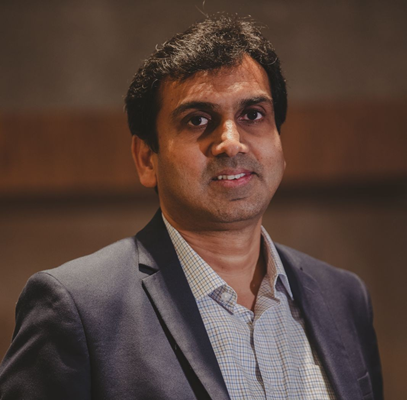
At a moment when early-stage funding fell 31 percent in the first half of 2025 and 11,223 Indian startups shut down under the weight of weak unit economics, Hyderabad Angels Fund moved against the tide, deploying INR 100 crore in venture capital to back early-stage startups across gaming, space technology, and consumer tech.
IndiaTechDesk spoke with Kalyan Sivalenka, Managing Partner at Hyderabad Angels Fund (haf.vc), to decode the fund’s investment mindset and highlight growing confidence in India’s maturing venture capital ecosystem. As many investors retreat during the funding winter, haf.vc treats the market correction as an opportunity, deploying capital into early-stage startups and taking a contrarian position that challenges conventional thinking on India’s startup slowdown.
During the conversation, Sivalenka revealed Hyderabad Angels Fund counterintuitive investment thesis, stating that market corrections create the best opportunities for disciplined capital. From his two-decade journey from investment banking to entrepreneurship and now to venture capital, he has learned that volatility separates serious founders from opportunists, and right now, India’s startup ecosystem is undergoing exactly that kind of separation.
During the tete-a-tete, Sivalenka revealed that his path to venture capital wasn’t linear. After founding Springforth Capital Advisors, an advisory firm that helps growth-stage companies raise capital, he experienced a fundamental shift in perspective.
He said, “I realized I wanted to move from advising entrepreneurs to backing them directly.” That transition shaped his entire investment philosophy, and he doesn’t just evaluate business plans; he understands the operational struggles founders face because he’s lived them.
This experience manifests in Hyderabad Angels Fund’s approach to due diligence. When evaluating startups, Sivalenka looks beyond pitch decks to examine whether founders have completed necessary pivots and truly understand their unit economics.
“If you’re not profitable at the unit economics level over a reasonable period, something is fundamentally wrong. Entrepreneurs need to think as a combination of new-age startup founders and old-age businessmen,” he said.
Betting Against the Grain
The timing of Hyderabad Angels Fund INR 100 crore fund launch initially appears baffling as early-stage funding in India dropped 31 percent year-over-year in the first half of 2025, with seed-stage funding plummeting 30 percent to $1.1 billion. However, Sivalenka interprets these numbers differently from most market observers.
“Early-stage investing in India is coming of age. What we’re seeing is natural consolidation or course correction rather than a long-term slowdown. Investors and family offices backing venture capitalists now understand the key factors they need to evaluate,” he added.
The fund has already deployed capital into three investments that illustrate this thesis. First came Stan, a Bangalore-based gaming platform that raised $8.5 million from Google, Nazara, and gaming giants like Bandai Namco and Square Enix. With 25 million downloads, Stan positions itself as India’s answer to Discord, built explicitly for Gen Z gamers in tier-2 and tier-3 cities.
“Nepal’s government recently crumbled on Discord because that’s where Gen Z congregates,” Sivalenka said. “Stan stands tall in comparison with Discord in terms of Indian user numbers. We invested in the marketplace where the entire gaming form takes shape rather than betting on specific games.”
The Space Tech Conviction
Hyderabad Angels Fund’s second investment went to Dhruva Space, a satellite manufacturing company riding India’s expanding space economy. This bet reflects the belief that India’s private space sector is transitioning from technology demonstrations to commercial viability. Companies like Dhruva Space recently launched LEAP-1, India’s first privately-built full-stack commercial satellite mission, proving that Indian startups can compete with global operators.
”We’re looking at opportunities in space tech and clean tech where we have high conviction. The upcoming investments will show us leading rounds rather than just co-investing,” Kalyan Sivalanka told IndiaTechDesk.
This willingness to lead rounds marks an evolution in Hyderabad Angels Fund strategy. While all three initial investments involved co-investing with prominent venture capitalists, Sivalenka indicated the fund will increasingly take the lead in sectors where it identifies unique opportunities before they hit conventional venture capital radar.
Despite aggressive deployment in gaming and space tech, haf.vc maintains conspicuous caution around quick commerce, perhaps the hottest sector in Indian venture capital right now. Sivalenka revealed that the fund evaluated one quick commerce opportunity at an advanced stage but ultimately paused.
“The dark store logistics model isn’t yet proven,” he said. “Quick commerce can be divided into two components, the larger play, where brands participate and the delivery infrastructure. That segregation hasn’t happened yet. Consumer behavior is still evolving, and we want to wait until suitable categories emerge.”
This disciplined approach to passing on hot deals reveals the fund’s underlying philosophy. As a CFA charterholder with investment banking experience, Sivalenka applies financial rigor that many early-stage investors skip in favor of growth-at-any-cost narratives.
The Unit Economics Reckoning
As the conversation inevitably turned to why over 11,223 startups shut down in 2025. Government data shows that 41 percent closed due to funding freezes, 27 percent due to compliance issues, and 19 percent due to talent churn. However, Sivalenka identified a deeper problem and emphasized the fundamental issue of broken unit economics.
”Companies are spending INR 100 to earn INR 1,” he said. “Most failures trace back to burn rates exceeding 15 percent of monthly revenue. In the process of scaling faster than competitors, founders forgot basic business fundamentals.”
This observation carries particular weight coming from someone who advised growth-stage companies before becoming an investor. Sivalenka witnessed firsthand how startups that ignored unit economics eventually hit walls, regardless of how much capital they raised or which prestigious venture capitalists backed them.
Hyderabad Angels Fund’s investment criteria directly address this issue. The fund targets companies that have completed pivots, understood their growth trajectory, and demonstrated commitment to profitability, even if they’re still burning capital to scale.
“We look for founders who know exactly where they’re pivoting after doing the needed learnings,” Sivalenka said.
The Seven-Year Commitment
Unlike investors seeking quick exits, Hyderabad Angels Fund commits to holding periods of 7 or 8 years. This patient capital approach proves particularly valuable during market corrections when founders need partners who understand that building category-defining companies requires time.
The fund plans to invest INR 2-4 crore per startup across 15-20 companies, with reserves for follow-on rounds. Hyderabad Angels Fund has already secured 62 percent of its target corpus and is in advanced discussions to raise its first institutional check. The INR 100 crore corpus includes an INR 50 crore green-shoe option.
”As a new fund with a long runway, we can commit for the duration needed to find unique opportunities, not just market deals,” Sivalenka said. “We want to identify credible founders across India and help them build companies that are both innovative and sustainable.”
Operating from Hyderabad positions haf.vc to access opportunities that Bangalore and Mumbai-centric venture capitalists might miss. India’s startup landscape is evolving beyond metros, with companies like Stan finding explosive growth in tier-2 and tier-3 cities where traditional venture capital has limited presence.
This geographic diversification aligns with broader trends in Indian venture capital. While Bangalore remains the dominant startup hub, cities like Hyderabad, Pune, and Chennai are producing increasingly sophisticated entrepreneurs who understand both technology and sustainable business models.
The Forward View
Looking ahead, Sivalenka identified three sectors where haf.vc will concentrate future investments. These sectors are clean tech, consumer technology, and enterprise SaaS. The fund actively scouts opportunities in generative AI, drones, healthtech, and fintech, though Kalyan Sivalenka emphasized that sector selection matters less than founder quality and unit economics.
”We’re not chasing sectors, we’re backing founders who understand their businesses deeply,” he said. “The best opportunities often come from categories that don’t fit neatly into conventional venture capital boxes.”
This founder-first philosophy extends to haf.vc’s operational approach. Beyond capital, the fund provides access to Hyderabad Angels Network’s ecosystem of over 300 members, creating networks that help portfolio companies scale efficiently. Ex-ITC executive director Pradeep Dhobale serves as fund chairman, bringing corporate governance expertise that complements Sivalenka’s financial acumen.
For founders navigating India’s brutal startup environment, Sivalenka offered clear advice.
“Focus on unit economics first, growth second. The companies surviving this correction are those that can stand on their own financially. Markets evolve quickly, and flexibility combined with sustainable economics makes the difference between success and shutdown.”
That philosophy, contrarian yet grounded in fundamental business principles, explains why Kalyan Sivalenka writes checks while others retreat. In a market defined by closures and funding freezes, Hyderabad Angels Fund’s INR 100 crore commitment represents more than capital deployment.
It signals a belief that India’s startup ecosystem is maturing from a growth-at-any-cost model to one of value creation. The maturity establishes that transition creates opportunities for investors disciplined enough to separate signal from noise.
Stay ahead of the curve and follow IndiaTechDesk on Facebook, Twitter and Linkedin for in-depth news of market trends, funding updates, and regulatory changes affecting startups in India.
Read More:
- Top Five Women Led Unicorn Startups of India Changing the Business Landscape
- Indian startups can apply for the ‘Digital India AatmaNirbhar Bharat Innovate Challenge’ till 18th July 2020
- AI Security Startup P0 Secures $6.5 Million in Seed Funding Led by Lightspeed Venture Partners
- Raptee Raises $3 Million in Pre-Series A Funding to Speed up EV Manufacturing
- From Boom to Bust, Understanding the Current State of Indian Unicorns and What Lies Ahead