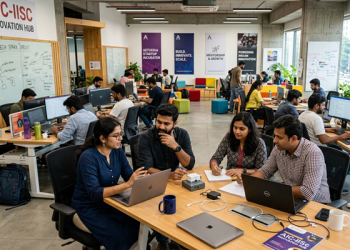



In 2025, 11,223 Indian startups shut down, a startling 30 percent jump from last year’s 8,649 closures, reshaping how venture capital flows, how early-stage founders pitch their dreams, and whether the next generation of entrepreneurs can afford to take risks with early-stage startup funding crunch.
The landscape has shifted dramatically. India’s startup ecosystem, once celebrated as the world’s third-largest innovation engine, now faces a reckoning. According to Tracxn data, more than 28,000 startups have shut down over the past two years.
Roughly 12 times higher than the 2,300 closures recorded between 2019 and 2022 combined. This acceleration has left investors skeptical, founders burned out, and early-stage ventures gasping for capital that no longer exists.
The damage spans multiple sectors. B2C e-commerce leads the collapse with 5,776 shutdowns, followed by enterprise software at 4,174 and SaaS at 2,785. Meanwhile, the sectors once hailed as innovation gold mines, such as edtech, fintech, healthtech, and agritech, are bleeding in the triple digits. These were the very verticals that attracted billions during the 2020-2022 boom.
What’s more troubling is that startups are dying earlier. In 2025, seven startups shut down within a year of inception, compared to just one in 2024. This means failures are accelerating before founders even have time to pivot.
The Startup Funding Freefall
The capital drought is real. Indian startups raised just $2.1 billion across 240 deals in Q3 2025. A crushing 38 percent year-on-year drop from $3.4 billion in Q3 2024. Seed funding, traditionally the lifeblood of early-stage ventures, crashed to $129 million—down 38 percent year-over-year. For first-time founders, this means fewer angels willing to bet on untested ideas.
Yet here’s the twist: while overall funding contracts, early-stage funding rose modestly by 8 percent to $598 million. Some investors are still backing fresh ventures, but only the strongest pitches survive. Early-stage deals account for 76.2 percent of total funding, suggesting that venture capitalists are laser-focused on younger companies with proven concepts.
“The highest number of exits was observed in B2C e-commerce, followed by enterprise software and SaaS. This trend highlights the challenges startups face in achieving product-market fit and building sustainable business models,” said Neha Singh, Co-Founder of Tracxn.
Consequently, seed-stage investors now demand clearer proof of traction before writing the first check. Where a founder might have raised $200,000 on a napkin sketch three years ago, today they face 15 investor rejections before landing one “maybe.” The confidence that once propelled founders forward has evaporated, replaced by a suffocating caution.
The Compliance Squeeze
Funding freezes account for 41 percent of closures, while compliance fatigue accounts for 27 percent. Early-stage founders now juggle regulatory hurdles alongside product development and customer acquisition—an exhausting trifecta. Talent churn accounts for another 19 percent of failures, as employees flee uncertain startups for stable tech jobs.
Angel investors, traditionally the first supporters of raw ideas, are now demanding much more. According to Angel Investment Network’s 2025 survey, 21 percent of investors cite overoptimistic financials as the biggest startup flaw, followed by unrealistic paths to profitability at 20 percent. Founders can no longer hide behind growth-at-all-costs narratives.
Remarkably, 40 percent of angel investors plan to invest more in 2025 than in 2024, and 39 percent plan to maintain the same level. However, this cautious optimism comes with strings attached: 70 percent of angels prioritize a clear value proposition, 59 percent demand founder transparency, and 56 percent require relevant team experience.
Meanwhile, venture capital firms are restructuring their portfolios. In 2025, nearly 60percent of new fund launches targeted seed and Series A rounds. This strategic focus reflects investor belief that smaller, nimble startups can outperform in uncertain times.
The Human Cost: Founders and Teams Pay the Price
Beyond the statistics, a human crisis unfolds. According to Dwipa Shah, a fintech expert, over 40,000 employees were laid off in 2025. Many received no severance. Teams dissolved via email. Founders deleted Slack channels, their dreams archived in cloud storage.
“Behind every number, there’s a dream that didn’t make it,” said Sujay U, Senior Analyst at AB InBev. “A founder who worked 16-hour days, a family that believed this time it would work, and a team that gave their all until the lights went off for the last time.”
The psychological toll runs deep. Burnout is not a buzzword—it is the new normal. Founders who rode the pandemic-era wave of easy capital now face a lonelier, slower grind.
Not all sectors face an ice age. Quick commerce, led by Zepto’s massive $202 million Series F round, remains well-funded. Transportation and logistics technology surged 104 percent to $1.6 billion. Enterprise applications and retail tech each captured over $1 billion in revenue.
Moreover, early-stage funding for AI-led startups remains robust. Around 60 percent of institutional investors allocated 20 percent of their portfolios to AI ventures in Q3 2025. This suggests that founders building AI tools, deeptech solutions, and climate-tech innovations still have pathways to capital.
What Comes Next?
India’s government is stepping up. The Fund of Funds for Startups (FFS) has committed INR 9,994 crore to 141 Alternative Investment Funds. In July 2025, the government expanded this program by another INR 10,000 crore to strengthen early-stage finance. The Credit Guarantee Scheme for Startups now covers collateral-free loans with reduced fees for champion sectors.
Furthermore, angel investment networks are evolving. SEBI’s September 2025 overhaul of angel fund regulations expanded thresholds from INR 10 lakh to INR 25 crore, making it easier for accredited investors to back early-stage ventures.
The age of “move fast and break things” is over. Founders must now obsess over unit economics, customer retention, and realistic paths to breakeven. Investors increasingly favor sustainable models over flashy pitch decks.
Yet India’s startup DNA remains intact. By October 2025, over 1.9 lakh registered startups were continuing to operate under the DPIIT framework, creating 16.6 lakh jobs. Five startups joined the unicorn club in 2025 alone—Netradyne, Drools, Porter, Fireflies AI, and Jumbotail.
The ecosystem did not collapse; it contracted and recalibrated. Founders embracing lean operations, seeking mentorship via government incubators, and focusing on real customer problems are finding pathways forward.
The 11,223 startup closures in 2025 represent not an extinction event, but a reset. Early-stage founders now face a harsher reality: capital is scarce, investors demand proof, and the runway has shortened. Yet for those building sustainable ventures with transparent financials and genuine customer traction, funding remains available. The lesson is simple: the era of easy money has ended. The era of earned credibility has begun.
Stay ahead of the curve and follow IndiaTechDesk on Facebook, Twitter and Linkedin for in-depth news of market trends, funding updates, and regulatory changes affecting startups in India.
Read More:
- How this Shopify Accelerator Startup is Assisting New Consumer Brands to Become Top Favorites During the Pandemic?
- Indian startups can apply for the ‘Digital India AatmaNirbhar Bharat Innovate Challenge’ till 18th July 2020
- AI Security Startup P0 Secures $6.5 Million in Seed Funding Led by Lightspeed Venture Partners
- Raptee Raises $3 Million in Pre-Series A Funding to Speed up EV Manufacturing
- From Boom to Bust, Understanding the Current State of Indian Unicorns and What Lies Ahead