

Women-led startups in India are redefining entrepreneurship, attracting unprecedented investment and reshaping the country’s startup ecosystem with fresh energy and bold ambition. As per Tracxn Data, Women-led startups have crossed $8 billion in funding across more than 1,900 rounds and have produced seven unicorns, 60+ acquisitions, and 10 public listings.
This remarkable achievement positions India as the second-largest ecosystem globally for women-led startup funding after the United States, with a cumulative capital mobilization of $26.4 billion to date.
As of 2024, more than 7,000 active women-led startups now operate in India, representing 7.5 percent of all active startups in the country. The five-year trajectory from 2020 to 2024 reveals a story of unprecedented growth followed by strategic consolidation, with 2021 marking the apex year at $6.3 billion in funding.
The year 2021 marked a watershed moment as startups raised an astounding $6.3 billion, driven by the pandemic-fuelled digital boom and a surge in investor interest for tech-driven business models.
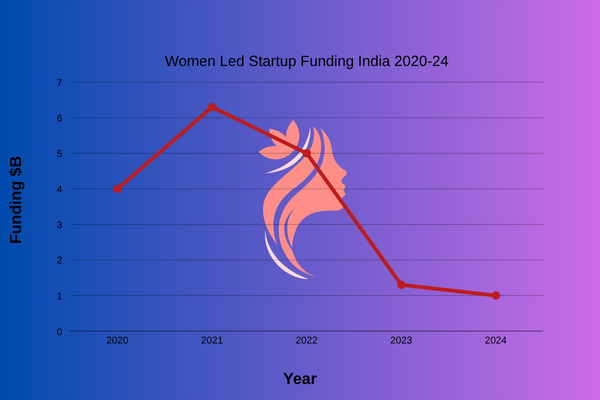
In 2022, funding fell to about $5 billion, yet India’s contribution to global women-led funding stood at 15.18 percent, the highest of any country that year. Even as the worldwide funding environment cooled, the women-led segment held strong.
Then the adjustment deepened when funding declined to approximately $1.3 billion in 2023, followed by $1.0 billion in 2024, a roughly 25 percent drop year-on-year. Despite this pull-back, the ecosystem of women-led startups in India continued to mature.
Early-stage funding nearly doubled from $550.5 million in 2021 to $1.1 billion in 2022, and women-led ventures captured 13.4 percent of early-stage capital in India in 2022—up from 7.8 percent previously. These shifts reflect more profound investor conviction and a shift toward more inclusive funding practices.
Sector Leadership: Where Women Entrepreneurs Excel
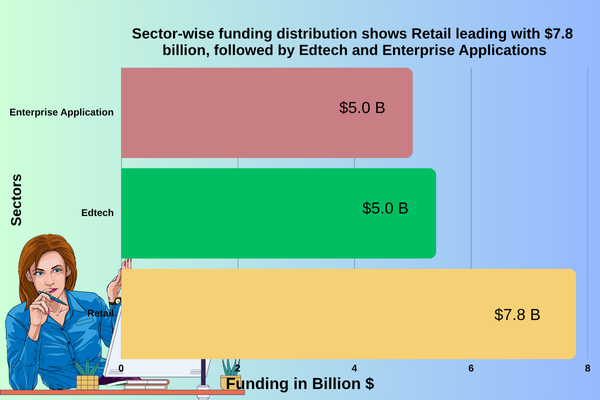
Women-led startups in India are not just growing in number; they are leading in sectors where innovation meets demand. The retail sector leads in cumulative investment, with about $7.8 billion raised by women-led ventures, thanks mainly to direct-to-consumer (D2C) brands and omnichannel beauty platforms.
Next comes edtech, with around $5.4 billion raised, by women founders building scalable learning and education-tech solutions. Enterprise applications, at roughly $5.0 billion, are a strong showing that signals women entrepreneurs are building robust B2B tech platforms, not just consumer brands.
In 2024 alone, fintech emerged as the leading sector for women-led startups in India, capturing $266.91 million—or 28.7 percent of total funding that year. E-commerce followed with $212.04 million (22.8 percent). Healthtech and cleantech each secured over $100 million, highlighting diversification beyond legacy categories and pointing toward the next wave of growth.
The journey of women-led startups in India toward scale has been impressive and instructive. 2021 saw the greatest wave of unicorn creation, with eight new unicorns emerging—an all-time high for this segment.
Numbers had grown steadily: three in 2019, four in 2020, five in 2022. Yet 2023 and 2024 saw no new unicorns, illustrating the headwinds of market contraction, increased scrutiny and the need for stronger operational discipline.
Acquisitions have been slowing down over the past few years. There were 45 deals in 2021, 36 in 2022, 25 in 2023, and only 16 in 2024. However, more women-led startups in India are choosing to go public instead.
In 2024 alone, five such companies were listed on the stock market. One standout example is a woman-led digital payments company that raised new funds and saw its stock jump 85 percent on the first day of trading—showing that successful public listings are now a real possibility for women entrepreneurs.
These results demonstrate that women-led startups in India can achieve scale, deliver value and provide liquidity—though the path is getting more demanding.
Geographic Spread and Emerging Hubs
The geographic map of women-led startups in India reveals both concentration and dispersion. The city of Bengaluru remains the dominant hub: it boasts the highest number of women-led startups in India, the largest funding volumes, a deep engineering and investor network and a strong innovation culture.
Mumbai follows, leveraging its role as India’s financial capital to house consumer-facing, fintech and media ventures. Delhi-NCR ranks third, benefitting from its proximity to policy-making and institutional frameworks.
Notably, about 49 percent of recognized women-led startups in India now operate in tier-2 and tier-3 cities—an indication of greater regional spread and inclusion. With better digital infrastructure, lower operating costs and rising local talent, women entrepreneurs beyond the metros are now building scale businesses.
Success Stories and Trailblazers
Several women-led startups in India have become reference points. For example, Falguni Nayar’s journey with Nykaa represents perhaps the most iconic women entrepreneurship success story in India. How a beauty-and-personal-care platform founded by a former investment banker redefined the D2C and omnichannel model in India, becoming the first major woman-led unicorn in the space and later listing publicly with strong investor reception.
Ghazal Alagh’s Mamaearth emerged from a deeply personal need—finding safe, toxin-free baby care products for her son. A venture launched around the personal need for toxin-free baby care products became a certified, household brand and reached unicorn status in 2022, showing how authenticity and category relevance translate into scale.
Upasana Taku’s MobiKwik journey showcases excellence in the fintech domain. After earning a B.Tech from NIT Jalandhar and an MS in management science and engineering from Stanford University, followed by experience at HSBC and PayPal, Taku co-founded MobiKwik in 2009 to democratize digital payments in India.
The company focused on serving users in tier 2 and tier 3 cities who had limited access to traditional banking services, offering mobile wallet services and financial product distribution through strategic partnerships with banks, NBFCs, and mutual funds.
MobiKwik achieved unicorn status in 2021 and launched its IPO in December 2024, raising INR 700 crore with shares surging 85 percent on debut. Despite facing gender bias in investor meetings and navigating a fiercely competitive fintech landscape, Taku’s resilience and strategic vision helped MobiKwik become one of India’s leading digital payment platforms with over 160 million users and 4 million merchants.
Challenges Confronting Women Entrepreneurs
Despite the progress, women-led startups in India face structural challenges. The funding gap remains stark: in a recent interval, while startups collectively raised $6.646 billion, women-led ventures secured only $300 million—just 4.5 percent of total capital, even though they represent ~7.5% of all active startups. Investor bias, higher scrutiny on women founders and tougher terms persist.
Access to credit and financial resources is another issue. Many women entrepreneurs rely on personal savings, which limits their growth potential. The venture-capital industry still has less than 5 percent of women in top investment roles, and only ~14 percent of fund-management roles held by women—a structural bottleneck.
Societal expectations also weigh heavily. Many women entrepreneurs balance domestic responsibilities and business roles, which may result in fewer networking opportunities. In smaller cities, cultural norms and a lack of role models can compound these challenges. Regulatory complexity and operational hurdles add further friction.
A significant number of startups terminate operations each year, and women-led ventures—given their comparatively smaller capital base—may be more vulnerable to follow-on-funding gaps.
Government & Ecosystem Support
The Indian government has launched several initiatives to strengthen women-led startups in India. Through the broader Startup India initiative, over 73,151 startups with at least one woman director have been recognized, representing nearly 48% of the total 152,139 startups supported under the scheme.
Dedicated funds, loans, guarantees and incubator programs target women founders. For example, a seed-fund scheme approved funding for over 1,278 women-led startups to the tune of INR 227.12 crore. A credit-guarantee scheme introduced loan guarantees of INR 24.6 crore for women entrepreneurs. Another fund invested INR 3,107 crore in 149 women-led startups via alternative investment vehicles.
At the state level, incubators exclusively for women, reserved startup-fund allocations (for example, 25 percent for women-led ventures), training programmes, and priority industrial plot allotments are becoming more common. Skill development, mentorship platforms, and networking initiatives help address non-financial constraints, making the ecosystem more supportive than ever.
Strategic Imperatives and the Road Ahead
Looking ahead, women-led startups in India have clear opportunities—and critical strategic imperatives. Sustained financial backing, stronger mentorship and institutional support will be vital, especially in a funding-constrained world. As investor focus shifts toward profitability, unit economics and sustainable growth, women founders will need to build sharper business models and operational rigour.
Emerging sectors offer rich opportunities. Women entrepreneurs are increasingly entering AI, machine-learning, cleantech, healthtech and sustainability-focused ventures—domains likely to define the next decade. The B2C e-commerce space, too, continues to offer innovation potential for women-led startups in India, especially in fashion tech, direct-to-consumer brands and underserved regional markets.
Representation in venture-capital decision-making is crucial. With less than 5 percent women in top VC roles, increasing diversity in investment teams will help reduce unconscious bias and improve capital access. Corporate partnerships and acquisitions will provide alternative growth and exit pathways. While acquisition numbers have fallen from 45 to 16 in short order, the trend toward strategic discipline suggests that women-led startups in India that focus on profitability, relevance and robustness stand to benefit.
By 2030, women-led startups in India are projected to contribute significantly to job creation—potentially generating 150–170 million additional jobs. That’s not just economic value—it’s social transformation. With over 7,000 active ventures now in the ecosystem, and strong foundations already built, the next phase is about scaling up a notch and expanding reach.
If the ecosystem—government, investors, corporates, founders—aligns effectively, the journey from $8 billion toward tens of billions in funding, from seven unicorns toward dozens, and from 7,000 active ventures toward many more thousands is not only plausible—it’s probable.
The Road Ahead
In the span of five years, women-led startups in India have charted a remarkable trajectory. With more than $8 billion raised, seven unicorns created, 60+ acquisitions and 10 public listings, women entrepreneurs have demonstrated that they can build, scale and exit companies at pace. Their strength spans retail, edtech, enterprise applications and now rising sectors like fintech and cleantech.
At the same time, the ecosystem is now entering a phase of consolidation—funding has corrected, exits have slowed, and the path ahead demands deeper focus, stronger fundamentals and broader inclusion.
Government schemes and ecosystem support have made substantial headway, but the work is far from complete. Only by bridging the funding gap, expanding mentorship, and ensuring representation in investor and corporate leadership will the full promise of women-led startups in India be realized.
As India moves toward its $5 trillion-economy goal, women entrepreneurs will occupy an increasingly central role in innovation, employment and inclusive growth. With the foundation already laid and with a sharper strategy ahead, the next five years hold immense transformational potential—and for women-led startups in India, the opportunity is wide open.
Stay ahead of the curve and follow IndiaTechDesk on Facebook, Twitter and Linkedin for in-depth news of market trends, funding updates, and regulatory changes affecting startups in India.
Read More:
- Top Five Women Led Unicorn Startups of India Changing the Business Landscape
- Indian startups can apply for the ‘Digital India AatmaNirbhar Bharat Innovate Challenge’ till 18th July 2020
- AI Security Startup P0 Secures $6.5 Million in Seed Funding Led by Lightspeed Venture Partners
- Raptee Raises $3 Million in Pre-Series A Funding to Speed up EV Manufacturing
- From Boom to Bust, Understanding the Current State of Indian Unicorns and What Lies Ahead